AI SDR vs AI Sequencer: What They Are and Which One You Need
HotHawk is cold email software for serious outbound teams.
Special offer
Get 50% more sending, FREE.
50% extra sending on any plan, every month.
On this page
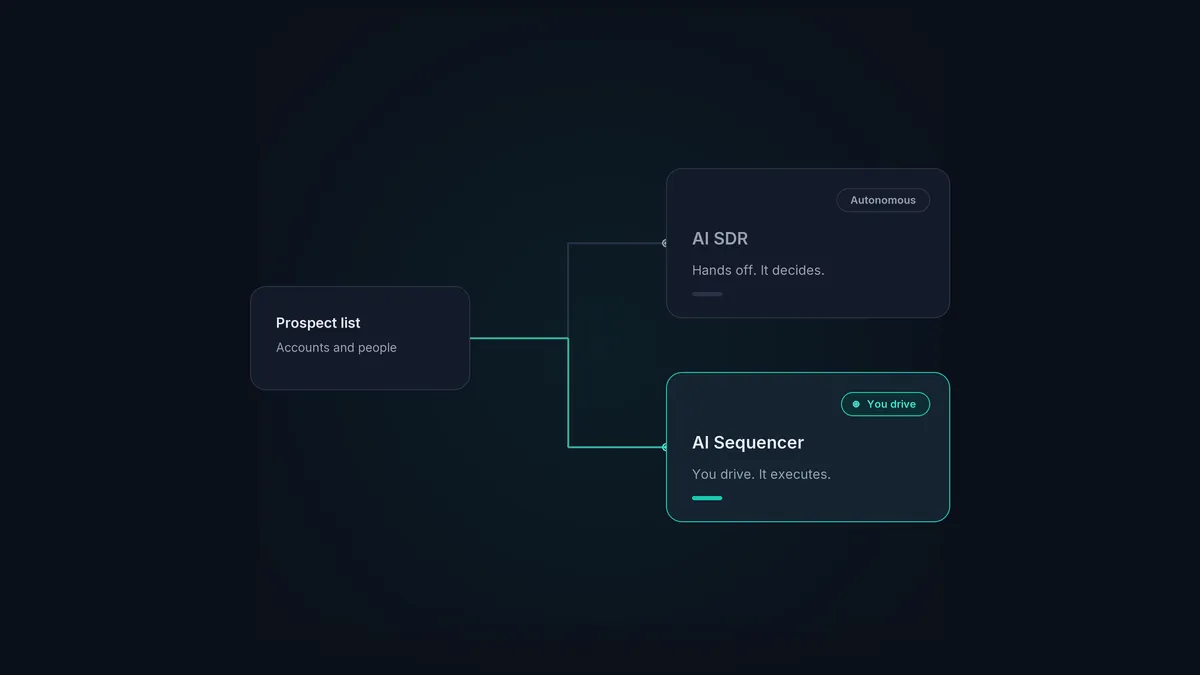
There are two very different things being sold under the AI banner in cold email right now, and the words have blurred into one. One is an “AI SDR”: software that tries to do the whole prospecting job for you, from picking accounts to sending and replying, with as little human input as possible. The other is an AI sequencer: a cold email tool you drive in plain language, where the AI does the work and you keep the judgement.
They sound similar. They’re built on opposite bets about how much you should hand over. This guide pulls them apart, shows what each one actually does today, and helps you pick the one that fits how your team sells. It’s the hub for everything in this section, so follow the links to go deeper on any piece.
The short version
- An AI SDR aims to automate the full prospecting role: research, send and reply with minimal input.
- An AI sequencer runs the cold email mechanics and leaves targeting and judgement with you.
- Most teams get burned by full autonomy and do better directing the work themselves.
- The newer model is running your cold email tool from an AI assistant like Claude over MCP.
- Pick by how much judgement your outbound needs, not by which label sounds more advanced.
What an AI SDR actually is
An AI SDR is software pitched as a replacement for the human sales development rep. Point it at a market and the promise is that it researches accounts, writes and sends personalised outreach, and even handles the early back-and-forth, all on its own. For a fuller breakdown of the role it claims to replace, start with what an AI SDR is.
The appeal is obvious. Hiring, ramping and managing SDRs is slow and expensive, so “software that does the SDR job” is an easy thing to want. The category has real money behind it, and a crowded field of tools all competing on how autonomous they claim to be.
Where it gets shaky is the autonomy itself. A tool that picks the wrong accounts and emails all of them on its own doesn’t save you work, it manufactures it, at volume, straight into your domain reputation. The further you hand over targeting and messaging, the more a weak ICP or a thin offer gets amplified instead of caught.
What an AI sequencer is
An AI sequencer takes the opposite bet. It runs the parts of cold email that genuinely benefit from automation, the sending, the timing, the warmup, the reply triage, and leaves the decisions that need a human with you. You still own who you target and what you say. The tool just does the doing.
HotHawk is built this way. Every feature in the product has an API endpoint, and every endpoint is in our native MCP server, so you can run the whole operation from Claude in plain language: build a campaign, add a lead list, pull the numbers, pause a losing variant. You get a lot of what people want from an AI SDR without handing over the keys.
That phrase matters. The job an AI is good at here is the repetitive mechanics. The job it’s bad at is deciding your strategy. An AI sequencer is drawn along that line on purpose.
The real difference: who holds the judgement
Strip away the marketing and the split comes down to one thing.
- An AI SDR tries to hold the judgement too. It decides who to contact, what to say, and how to handle the reply, and asks you to trust the output. When it’s right, it feels like magic. When it’s wrong, you don’t find out until the bad outreach has already gone.
- An AI sequencer leaves the judgement with you. You set the targeting and the message; the AI executes and reports back. It’s less hands-off, and far harder to break in a way that costs you a domain.
For most teams the second model wins, because outbound punishes bad judgement more than it rewards saved clicks. The teams that do well with heavy automation are the ones whose ICP and offer are already dialled in, so there’s less judgement to get wrong in the first place.
Running cold email from an AI assistant
The most useful version of “AI in cold email” in 2026 isn’t a separate AI SDR product at all. It’s connecting your real cold email tool to an assistant you already use, and running it by asking.
That’s what MCP changes for cold email teams. The Model Context Protocol is the open standard that lets a model like Claude call the tools inside HotHawk directly. You connect it once as a custom connector, no code, then drive campaigns, replies and reporting from the chat window. The full AI cold email workflow with Claude Code walks through what a day of that actually looks like.
If you’re weighing up the assistants themselves, Claude Code vs Cowork covers the differences that matter for a sales team. Most cold email platforms still don’t offer this at all.
Run cold email from Claude
HotHawk's native MCP server puts every feature in reach of your AI assistant. Build campaigns, work replies and pull analytics in plain language, while you stay in control.
See AI and Claude workflowsWhere AI genuinely earns its place
Set the autonomy debate aside and AI does real, unglamorous work in cold email that’s well worth having:
- Personalisation that goes past a merge field. There’s a real gap between dropping
[First name]into a template and writing a line that shows you understood the account. AI personalisation vs template variables covers where each one actually helps. - Acting on signals instead of static lists. The strongest outbound reacts to a trigger, a hire, a funding round, a product launch, rather than blasting a list you bought six months ago. The signal-based outbound with AI agents playbook covers how to wire that up.
- Sorting the replies. Once campaigns are live, the daily grind is triage. AI reply handling for cold email sorts positive from negative from out-of-office, and our reply categorisation puts the ones that matter in front of a rep first.
None of this replaces the rep. All of it gives the rep their day back.
So which one do you need?
Answer it with a question about your own outbound, not about the tools.
If your ICP and offer are still moving, you need to keep judgement close, so an AI sequencer you direct is the safer bet. You’ll catch the misfires before they cost you, and you’ll learn faster because you can see exactly what’s being sent and why.
If your ICP and offer are locked and proven, you can lean harder on automation, because there’s less to get wrong. Even then, the version most teams are happiest with isn’t a black-box AI SDR but a tool they can drive from an assistant and inspect any time they want.
For nearly everyone, the honest answer is the same: you want the AI doing the work, not making the calls. That’s the bet HotHawk’s email sequencer and reply management inbox are built on, and it’s why the MCP server and API put the whole product in reach of your AI without ever taking your hands off the wheel.
A few common questions
What’s the difference between an AI SDR and an AI sequencer? An AI SDR tries to automate the whole prospecting job, including who to contact and what to say. An AI sequencer automates the mechanics of cold email, sending, timing, warmup and reply triage, and leaves the targeting and messaging decisions with you.
Can AI run my cold email by itself? It can run the mechanics by itself, and increasingly you can drive those mechanics from an AI assistant like Claude over MCP. Handing it the strategy, who to target and what to say, is where teams get burned, because mistakes go out at volume before you spot them.
Do I need an AI SDR to use AI in cold email? No. The most practical use of AI today is connecting your existing cold email tool to an assistant and running it by asking, which gives you the speed of automation while keeping the judgement human.
The labels will keep shifting, but the real question doesn’t. Decide how much of your outbound judgement you’re willing to hand to software, keep that part close, and let AI do the rest at a scale no human team could match.
