Best AI SDR Software in 2026: How to Choose, Not Just a List
HotHawk is cold email software for serious outbound teams.
Special offer
Get 50% more sending, FREE.
50% extra sending on any plan, every month.
On this page
Search “best AI SDR software” and you get a dozen listicles with the same fifteen tools in a different order, usually ranked by who paid for the slot. Not much use when you’re actually trying to choose. What is useful is understanding the three camps the market splits into, because the right tool for you depends entirely on which camp fits how you sell.
So this is a buyer’s guide, not a leaderboard. It covers the three types of AI SDR software, what separates a good one from a demo, and the questions that actually decide the pick.
The short version
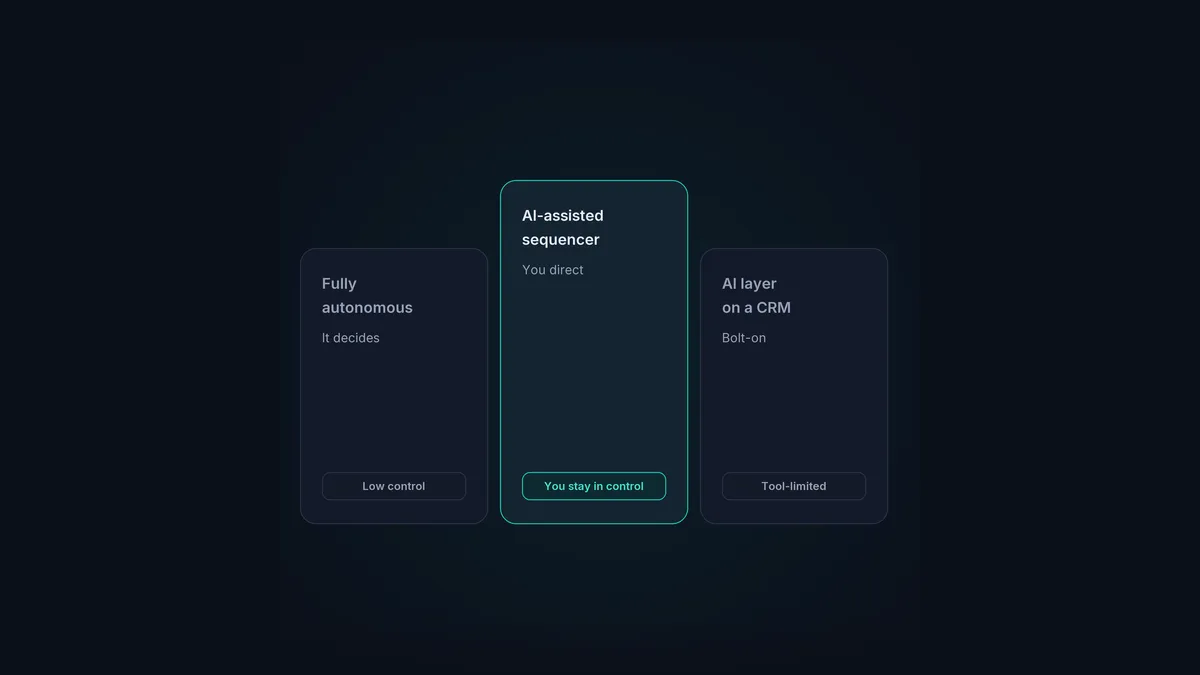
- AI SDR software falls into three camps: fully autonomous, AI-assisted sequencers, and AI layers on existing tools.
- Autonomy is a risk as much as a feature; more hands-off means mistakes go out before you see them.
- Judge tools on coverage and control, not on how many AI features they list.
- The most practical pick for most teams is one you direct from an AI assistant.
- Match the camp to whether your ICP and offer are still moving or already proven.
The three camps
Almost every “AI SDR” tool sits in one of three buckets. Knowing which is which saves you from comparing things that aren’t really comparable.
1. Fully autonomous AI SDRs. These aim to run the whole motion with barely any input: pick accounts, write, send, and handle early replies on their own. The pitch is a rep that needs no managing. The risk is that when the targeting or message is off, you find out after the bad outreach has gone, at volume, straight into your domain reputation.
2. AI-assisted sequencers. These run the cold email mechanics, sending, timing, warmup, reply triage, with AI helping at each step, while you keep the targeting and messaging decisions. Less hands-off, far harder to break expensively. This is where HotHawk sits.
3. AI layers on existing tools. These bolt AI features, drafting, scoring, summarising, onto a CRM or sales platform you already use. Handy if you’re committed to that stack, but the AI is only as good as the underlying tool’s reach.
What separates a good one from a demo
Most AI SDR tools demo beautifully and disappoint by week three. The things that predict whether it holds up:
- Coverage, not feature count. Can it actually run the work you do daily, build campaigns, manage lists, work replies, check deliverability, or does it just draft openers? A long AI feature list often hides thin operational coverage.
- Control you can see. Can you inspect what it’s about to send, stage it, and adjust? Black boxes are fine right up until they’re wrong.
- Deliverability fundamentals. AI that sends faster into cold domains just burns them faster. Warmup, inbox rotation and sensible volume still decide whether you reach the inbox.
- Where it runs. More and more, the best “AI SDR” experience isn’t a separate product at all, but running your real cold email tool from an assistant like Claude, and few cold email platforms actually offer that yet.
How to pick for your team
Match the camp to your situation, not to the marketing.
If your ICP and offer are still moving, stay in camp two. You need to see and adjust what’s being sent, so an AI-assisted sequencer you direct is the safe, fast-learning choice. Full autonomy will just amplify a strategy you haven’t proven yet.
If your ICP and offer are locked and proven, you can lean harder on automation. Even then, most teams are happiest with a tool they can drive from an assistant and inspect at any point, rather than a black box. The trade-off between the two is the whole subject of the AI SDR vs AI sequencer guide.
If you’re tied to a CRM, look hard at camp three, but check the underlying tool can actually do outbound at volume with proper deliverability, not just store contacts.
Where HotHawk fits
HotHawk is an AI-assisted sequencer you direct. It runs the cold email backbone, multi-step campaigns with warmup and inbox rotation, and a master inbox that catches every reply, and it puts the whole product in reach of your AI assistant through a native MCP server. You get a lot of what people want from an AI SDR, the speed and the volume, without handing over the judgement. For the role itself, what an AI SDR is covers the ground.
An AI SDR you actually control
HotHawk runs the cold email work and lets you drive it from Claude, while you keep the targeting and the message. The speed of automation, with the judgement still yours.
See AI and Claude workflowsA few common questions
What’s the best AI SDR software? There’s no single best; there are three camps. Fully autonomous tools suit proven motions, AI-assisted sequencers suit most teams, and AI layers suit those tied to a CRM. Pick by how much control you need, not by who tops a listicle.
Is autonomous AI SDR software safe to use? It can be, once your ICP and offer are proven, because there’s less for it to get wrong. While those are still moving, full autonomy amplifies mistakes before you can catch them, so a tool you direct is safer.
Do AI SDR tools replace human reps? No. They replace the repetitive prospecting work, not the judgement, relationships and real conversations. The realistic model is AI doing the volume work so reps focus where humans win.
The honest ranking is the one you do yourself, against your own situation. Sort by control first, coverage second, and treat the AI feature list as the tiebreaker. Do that and “best AI SDR software” stops being a listicle and becomes a decision you can defend.
