AI Personalisation vs Template Variables in Cold Email
HotHawk is cold email software for serious outbound teams.
Special offer
Get 50% more sending, FREE.
50% extra sending on any plan, every month.
On this page
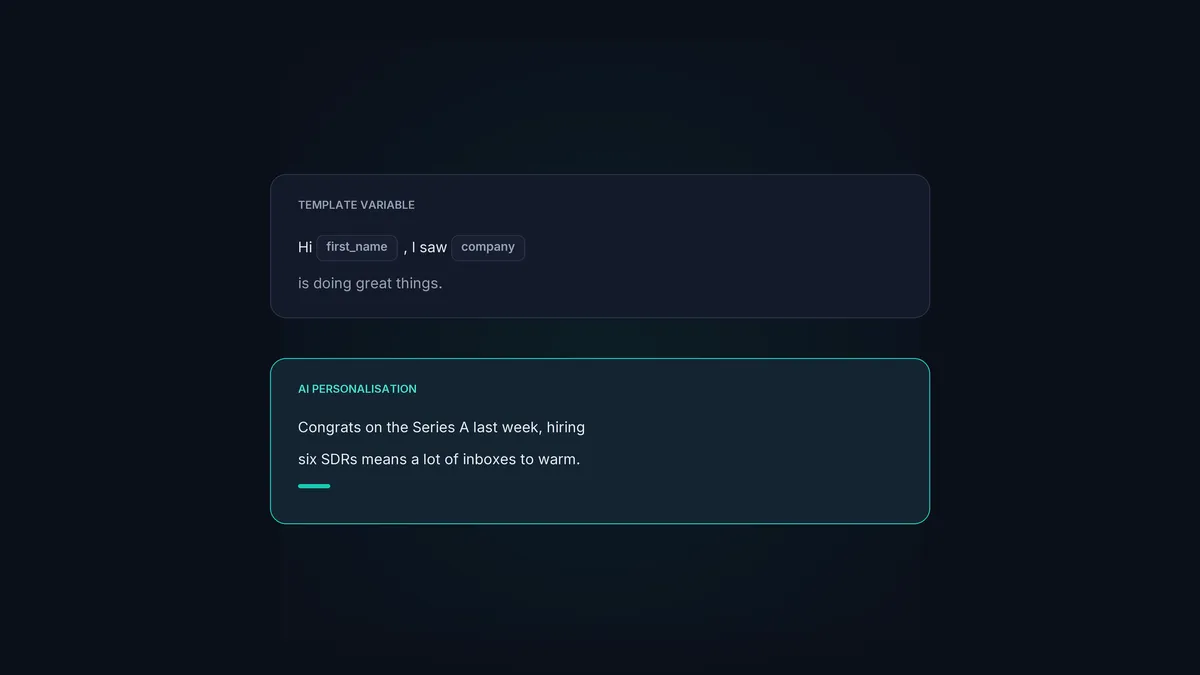
There are two very different things people mean by “personalised” cold email, and mixing them up is why so much “personalised” outreach still reads like a mailmerge. One is a template variable: a placeholder like {{first_name}} that swaps in a stored value. The other is AI personalisation: a line actually written for that prospect, based on who they are and what’s going on at their company.
Both have a place. Knowing which does what, and where each one falls down, is the difference between outreach that feels addressed to someone and outreach that feels processed.
The short version
- Template variables swap in stored data; they scale perfectly but show no real understanding.
- AI personalisation writes a relevant line per prospect; it shows understanding but needs good inputs.
- Variables fail when the data is missing or wrong, which a prospect spots instantly.
- AI personalisation fails when it has nothing real to say, producing confident filler.
- The best cold email uses variables for facts and AI for the one line that proves you looked.
What template variables actually do
A template variable is a placeholder you drop into a template, and the tool fills it from a field on the contact record. {{first_name}}, {{company}}, {{job_title}}. You write one email, the tool sends a thousand, each with the right name swapped in.
They’re the backbone of cold email for a reason: they scale without effort and never get tired. But they don’t personalise anything in the sense that matters. Hi {{first_name}}, I saw {{company}} is doing great things is a template wearing a name badge. The prospect has read a hundred of those, and they clock it in the first line.
Variables also fail loudly. A missing field gives you Hi , I loved your work at. A wrong field is worse, because confidently addressing someone by the wrong name or company is an instant delete. The more variables you stack, the more ways the email can break.
What AI personalisation actually does
AI personalisation writes the line instead of slotting in a value. Give it context about the prospect, their role, their company, a recent event, and it drafts something specific: a sentence that references the thing a human would have noticed if they’d done the research by hand.
Done well, this is the line that earns the reply, because it proves you looked. Done badly, it produces fluent, confident filler: a sentence that sounds personalised but says nothing, because the model had nothing real to work with. That’s the trap. AI will always write you a smooth line. It won’t always have a reason to.
Where each one wins
They’re not rivals; they do different jobs.
- Use template variables for facts. Name, company, role, location. Stored data you trust, swapped in reliably. The right tool for the parts of the email that are simply true.
- Use AI personalisation for the one line that proves you looked. The opener or the bridge that references something specific and current. One genuinely relevant sentence beats five generic ones.
- Don’t use AI to fake what you don’t know. With no real signal, a clean, honest, relevant email with good variables beats a fluent fake every time. Specific beats smooth.
The mistake is treating AI personalisation as a volume knob, “personalise every line”. That just multiplies confident filler. Treat it as a scalpel for the one line that counts.
How to combine them in practice
A strong cold email usually looks like this: variables carry the facts, one AI-written line carries the relevance, and the rest is a clear, human message about why you’re getting in touch. The structure of the cold email itself does the heavy lifting; personalisation just earns the read.
This is where running cold email from an assistant helps. With HotHawk connected to Claude over the MCP server, you can have it draft that one relevant line per prospect from real context, then send through campaigns that handle the variables, warmup and rotation underneath. The AI does the writing where writing matters; the platform does the mechanics. For the bigger picture on what AI does and doesn’t change, see the AI SDR vs AI sequencer guide.
Personalise the line that counts
Run cold email from Claude with HotHawk's MCP server: draft the one relevant line per prospect from real context, and send through campaigns that handle the rest.
See AI and Claude workflowsA few common questions
What’s the difference between AI personalisation and template variables? Template variables swap stored data, like a name or company, into a template. AI personalisation writes an original, relevant line for each prospect based on context. Variables handle the facts; AI handles the sentence that shows you understood the account.
Is AI personalisation better than mail merge? Only when it has real input. Given genuine signal, an AI-written line beats a generic template. Given nothing, it produces confident filler that’s worse than an honest, simple email with good variables.
Should I personalise every line with AI? No. Use AI for the one line that proves you looked, and template variables for the facts. Over-personalising just multiplies smooth, empty sentences and slows you down.
The useful framing isn’t AI versus variables, it’s facts versus relevance. Let variables carry what’s simply true, let AI carry the one line that proves you did the work, and refuse to fake the rest. That’s personalisation a prospect actually feels.
