How to Build a Cold Email Sequence From Scratch (Step-by-Step Guide)
HotHawk is cold email software for serious outbound teams.
Special offer
Get 50% more sending, FREE.
50% extra sending on any plan, every month.
On this page
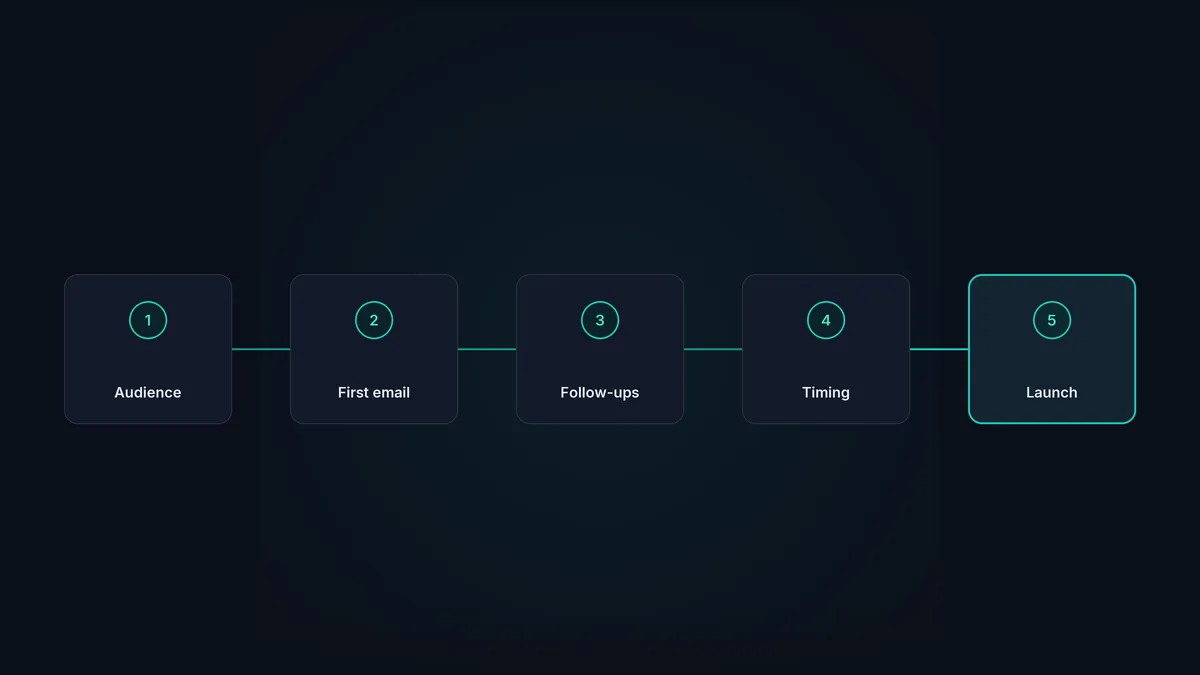
Building a cold email sequence is not complicated, but the order matters. Most people start by writing emails, when the email is the last thing you should worry about. Get the audience and the structure right first, and the copy gets much easier to write.
Here is the process from scratch, in the order that actually works: audience, first email, follow-ups, timing, then setup. The whole thing is the engine behind everything in the email sequencer guide.
The short version
- Start with the audience, not the copy. Relevance does more than wording ever will.
- Write a short first email with one clear ask, then add 2 to 4 follow-ups.
- Space the steps day 0, 3, 7, then wider, ending in a break-up.
- Deliverability is part of the build: warm up, rotate mailboxes, authenticate.
- Turn on reply detection so anyone who answers drops out of the sequence.
Step 1: Define the audience and the goal
Before a word of copy, decide exactly who you are emailing and what you want them to do. A tight, relevant list to the right role beats a brilliant email to the wrong people every time. Most weak sequences are not a copy problem; they are a targeting problem.
Get specific: the role, the company type, the trigger that makes them relevant now. And fix the goal, which for cold outreach is almost always a booked meeting. One audience, one goal, per sequence.
Step 2: Write the first email
Now the opener. Keep it short, relevant, and built around a single clear ask. A good cold email does three things fast: shows you understand their world, offers a reason to care, and asks for one small next step.
Resist the urge to say everything. The first email’s only job is to earn a reply, not to close the deal. One problem, one line of relevance, one ask. If you are staring at a blank page, the sales sequence examples give you openers to adapt.
Step 3: Add the follow-ups
This is where most of your replies will actually come from, so it is worth as much thought as the first email. Add two to four follow-ups, and give each one a distinct job:
- Follow-up 1: a new angle, not a repeat of email one.
- Follow-up 2: proof, a specific relevant result.
- Follow-up 3: a smaller ask, easier to say yes to.
- The break-up: tell them you will stop, and mean it. Often the highest-replying step.
The rule for every follow-up: add one new reason to reply. A bare “just checking in” teaches the reader to ignore you.
Step 4: Set the timing
Space the steps so you stay present without nagging. A reliable rhythm:
- First email - day 0
- Follow-up 1 - day 3
- Follow-up 2 - day 7
- Follow-up 3 - day 12 to 14
- Break-up - day 18 to 21
Close together early while the first email is fresh, then widen the gaps so you fade into the background rather than pestering. Send in working hours, in the prospect’s time zone.
Step 5: Set it up to run
Now you connect it to a sequencer and let it run. A few things to get right at setup:
- Connect your mailboxes and turn on inbox rotation so sends spread across them and no single mailbox does too much.
- Confirm warmup is running, so your sender reputation holds up under the new volume.
- Turn on reply detection, so anyone who replies is automatically removed from the remaining steps and a human can take over.
- Set the daily volume sensibly. Start conservative and ramp, rather than blasting from day one.
Then launch small. Send to a slice of your list first, read the replies, and fix the obvious problems before you scale the volume. A sequence is never finished on day one; the first batch of replies tells you what to change.
Build it once, let it run
HotHawk runs your sequence automatically with warmup and inbox rotation built in, and catches every reply in one inbox so nobody gets chased after they answer.
Start your 7 day free trialStep 6: Handle the replies
The point of all of this is to start conversations, so the last piece of the build is making sure you catch them. When you send from several mailboxes, replies scatter, including forwards and CC’d colleagues, and the good ones go cold if nobody sees them.
Route every reply into one reply management inbox, assign each to a person, and let reply detection pause the sequence for anyone who answers. A sequence that sends beautifully but drops its replies is only doing half the job.
A few common questions
How many emails should a cold email sequence have? Three to five: the first email plus two to four follow-ups, ending in a break-up. More than that tends to cost more than it returns.
What should the first email say? One problem you can speak to, one line of relevance to them, and one small clear ask. Keep it short; its only job is to earn a reply.
How do I stop emailing people who reply? Turn on reply detection in your sequencer. It pauses the remaining steps for anyone who answers, so a real conversation never collides with an automated follow-up.
Build in the right order, audience first and copy last, give the follow-ups real thought, get the deliverability foundations in place, and let a sequencer run the timing. Then read the early replies and refine. That is a cold email sequence that earns meetings rather than spam complaints.
