Sales Sequence Examples: 10 Multi-Step Sequences That Book B2B Meetings
HotHawk is cold email software for serious outbound teams.
Special offer
Get 50% more sending, FREE.
50% extra sending on any plan, every month.
On this page
The fastest way to build a good email sequence is to start from one that already works and adapt it. Below are ten multi-step sequences for common B2B situations, each broken down by step, timing, and the job each email is doing.
Treat them as structures, not scripts. The timing and the logic carry across; the words need your specifics dropped in, or they read as the templates they are. For the principles behind why these work, see the email sequencer guide, and to build one from scratch, how to build a cold email sequence.
The short version
- Most effective cold sequences run 3 to 5 steps over two to three weeks.
- Each step should do one job: intro, proof, new angle, or break-up.
- Start the steps close together, then widen the gaps.
- End with a break-up email. It is often the highest-replying step.
- Personalise one real line per email, or the structure shows through.
1. The classic cold outreach sequence
The default for reaching a cold prospect. Short, relevant, persistent without being pushy.
- Day 0 - Intro. One specific problem, one clear ask. “Quick question about [process].”
- Day 3 - New angle. Lead with a different benefit than email one. Shorter.
- Day 7 - Proof. A named result from a similar company. “How [company] got [result].”
- Day 12 - Smaller ask. “Is this a priority this quarter, yes or no?”
- Day 18 - Break-up. “I will close this out unless it is useful.”
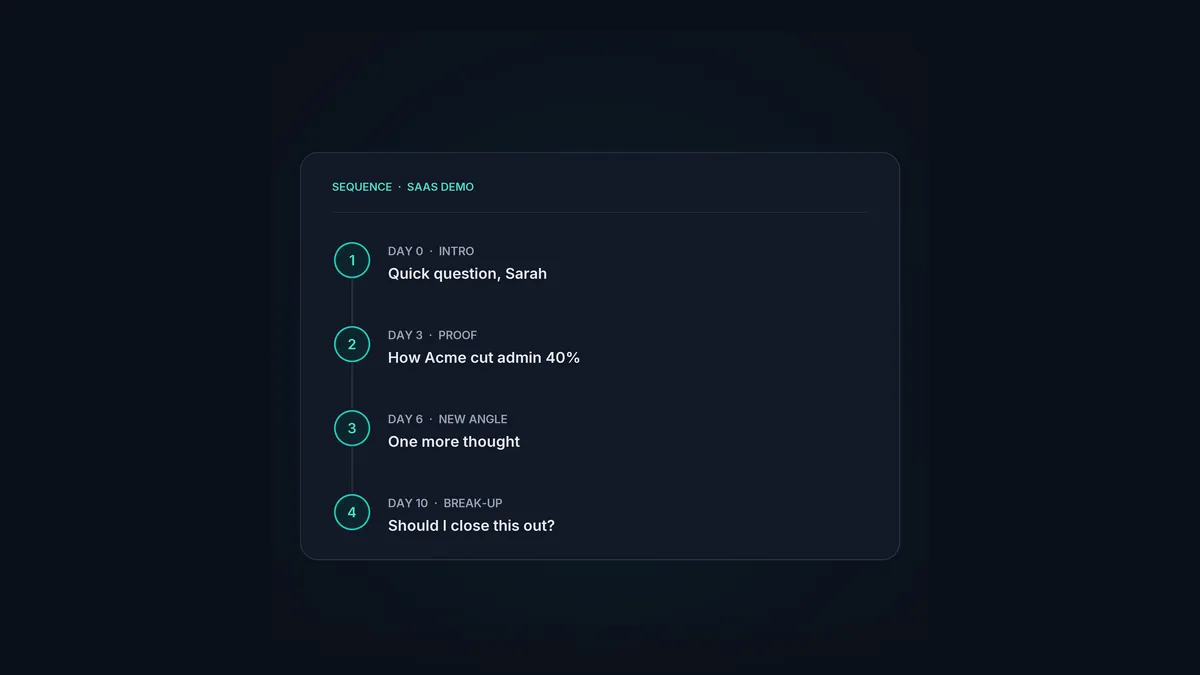
2. The SaaS demo sequence
For getting a product demo booked. Leans on a concrete outcome.
- Day 0 - Intro. The problem your product solves, in one line.
- Day 3 - Proof. A metric a comparable customer hit. “How Acme cut admin 40%.”
- Day 6 - New angle. A second use case they may not have considered.
- Day 10 - Break-up. “Should I close this out?”
3. The agency new-business sequence
For agencies pitching a service. Credibility and a low-friction first step matter most.
- Day 0 - Intro. A result you got for a client in their space.
- Day 4 - Case detail. One sentence on how you did it, plus a soft ask.
- Day 8 - Audit offer. A small, free piece of value: a quick teardown or idea.
- Day 14 - Break-up. Polite close with the door left open.
4. The re-engagement sequence
For old leads that went quiet months ago. Acknowledge the gap, do not pretend it is a fresh intro.
- Day 0 - Reconnect. “We spoke a while back about [thing], worth another look?”
- Day 4 - What changed. A new feature, result, or reason the timing is better now.
- Day 9 - Break-up. “Happy to leave it if the timing still is not right.”
5. The event or webinar follow-up sequence
For people who attended or registered. Speed matters; send while it is fresh.
- Day 0 - Thanks plus recap. A useful takeaway and one next step.
- Day 2 - Resource. The recording, slides, or a related guide.
- Day 6 - Ask. A specific suggestion to talk, tied to what they came for.
- Day 11 - Break-up. Close the loop.
6. The post-demo nudge sequence
For prospects who took a demo and went quiet. Keep momentum without nagging.
- Day 0 - Recap. What you covered and the agreed next step.
- Day 3 - Remove a blocker. Address the likely objection (price, timing, buy-in).
- Day 7 - Proof. A reference or result that de-risks the decision.
- Day 12 - Break-up. “Should I assume the timing is not right?”
7. The referral-ask sequence
For when you have reached the wrong person. Make the handoff effortless.
- Day 0 - Intro plus ask. The pitch, then “or is [role] the better person?”
- Day 4 - Easy handoff. “Happy to reach out to them directly if easier.”
- Day 9 - Break-up. Thank them and close.
8. The signal-based sequence
For when something triggered the outreach: a funding round, a new hire, a job posting.
- Day 0 - The signal. Reference the trigger and why it makes you relevant now.
- Day 3 - Proof. How others in the same moment used you.
- Day 7 - Break-up. Short, since the signal is time-bound anyway.
9. The founder-to-founder sequence
For founder-led sales. Warmth and brevity beat polish.
- Day 0 - Human intro. Plain, personal, no corporate gloss. Why you specifically.
- Day 4 - One result. A real number or story, briefly.
- Day 9 - Break-up. “No worries either way, good luck regardless.”
10. The multi-channel cadence backbone
For when email is the spine of a wider sales cadence that adds calls and LinkedIn.
- Day 0 - Email intro. (LinkedIn connect the same week.)
- Day 4 - Email follow-up. (Call attempt around the same time.)
- Day 9 - Email proof. (Second call.)
- Day 14 - Email break-up.
The email steps run on autopilot; the calls and social touches are slotted in by the rep. More structures in sales cadence examples.
Run these without the manual work
Every sequence above has the same operational need: send the steps on the right timing, across enough mailboxes to stay healthy, and stop the moment someone replies. Doing that by hand for more than a few prospects is impossible, which is the whole reason the email sequencer exists. It runs the steps automatically, with warmup and inbox rotation behind them, and pauses anyone who answers so a live conversation never collides with the next templated email.
Put your best sequence on autopilot
HotHawk runs your multi-step sequences automatically, with warmup and rotation built in, and catches every reply in one inbox. Try it free for 7 days.
Start your 7 day free trialA few common questions
How many steps should a sales sequence have? Three to five for most cold outreach: an intro plus two to four follow-ups, ending in a break-up. More than that tends to cost more than it returns.
How far apart should the emails be? Start close, around day 0, 3, and 7, then widen the gaps for the later touches up to a couple of weeks before the final email.
Can I just copy these templates? Use them as structures, not scripts. The timing and the purpose of each step transfer; the copy needs your specifics or it reads as a template.
Pick the example closest to your situation, adapt the copy to the person, and let a sequencer run the timing. The structure is the easy part; relevance and consistent follow-through are what turn a sequence into meetings.
