What Is a Sales Cadence? Plain-English Definition for B2B Sales Teams
HotHawk is cold email software for serious outbound teams.
Special offer
Get 50% more sending, FREE.
50% extra sending on any plan, every month.
On this page
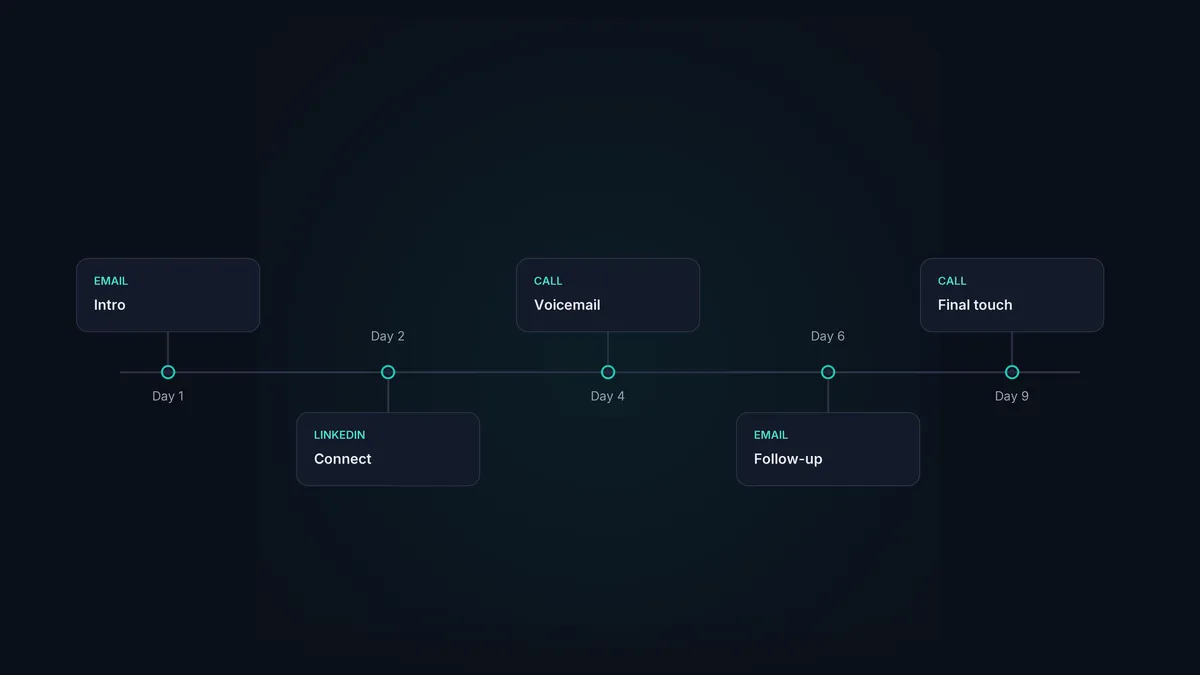
A sales cadence is a planned series of touchpoints, spread across channels and time, that a rep uses to move a prospect from first contact to a booked meeting. Email on day one, a LinkedIn connection on day two, a call on day four, another email on day six, and so on. The cadence is the schedule of who you reach, how, and when.
The word matters because it captures something a single email never does: outreach is a rhythm, not a one-off. One touch rarely books a meeting. A deliberate sequence of them, on the right channels at the right spacing, is what actually works.
The short version
- A sales cadence is a structured series of outreach touches across channels (email, call, LinkedIn) over a set period.
- It is multi-channel by definition. That is the main thing separating a cadence from an email-only sequence.
- A typical cadence runs 8 to 12 touches over 2 to 3 weeks, mixing channels.
- The point is consistency: every prospect gets the same deliberate treatment, not whatever the rep remembers to do.
- Email is usually the backbone, so a good email sequencer does most of the heavy lifting.
What a sales cadence actually is
Break it down and a cadence has three parts: the channels you use, the number of touches, and the timing between them. A simple B2B cadence might look like this:
- Day 1: email (intro)
- Day 2: LinkedIn connection request
- Day 4: phone call (likely a voicemail)
- Day 6: email (follow-up with a new angle)
- Day 9: phone call
- Day 12: email (break-up)
Six or so touches across three channels over a couple of weeks. The exact mix changes by team and market, but the shape is consistent: deliberate, varied, and spaced out.
The value is that it is a system. Without a cadence, outreach depends on whether a rep remembers to follow up, and most of the time they do not. With one, every prospect gets the same considered sequence of touches, which is why cadences are the backbone of any organised outbound team.
Sales cadence versus email sequence
These two terms get used interchangeably, and they overlap, but there is a useful distinction.
An email sequence is a series of emails: the steps, the timing, the follow-ups, all in one channel. A sales cadence is usually broader: a multi-channel plan that may include calls, LinkedIn, and other touches alongside the emails.
So an email sequence is often the email backbone inside a wider cadence. If your outreach is email-only, “sequence” and “cadence” describe much the same thing. Once you add calls and social touches, “cadence” is the better word for the whole plan. The mechanics of the email part are covered in the email sequencer guide.
How long should a sales cadence be?
Most effective B2B cadences run 8 to 12 touches over two to three weeks. That sounds like a lot until you remember it is spread across channels: a handful of emails, a couple of calls, a LinkedIn touch or two. No single channel is doing all the work, so it feels persistent without being annoying on any one of them.
Like email follow-ups, the touches should start closer together while you are fresh in mind, then widen out. And like any outreach, there is a point of diminishing returns: past a dozen or so touches you are mostly generating irritation, so the cadence should have a clear, deliberate end.
Where email fits, and why the sequencer matters
In almost every cadence, email is the backbone. It is the channel you can run at scale, automate reliably, and personalise without a human sending each one. The calls and LinkedIn touches are added around the email spine.
That is why an email sequencer does most of the heavy lifting in a cadence. It runs the email steps automatically, on the right timing, across your mailboxes, and pauses for anyone who replies, so the rep is freed up to handle the manual touches (the calls, the personalised LinkedIn notes) where a human genuinely adds value. The email engine keeps the cadence moving; the rep spends their time where it counts.
Automate the backbone of your cadence
HotHawk's email sequencer runs the email steps of your cadence automatically, with warmup and inbox rotation built in, so your reps can focus on the calls and conversations.
Start your 7 day free trialBuilding a sales cadence that works
A few rules keep a cadence effective rather than just busy:
- Lead with relevance, not volume. A short, relevant cadence to the right people beats a long one to the wrong ones.
- Vary the message as well as the channel. Each touch should add something: a new angle, a proof point, a question. Repeating the same pitch on three channels is still spam.
- Automate what you can, personalise what matters. Let the sequencer run the emails; spend your manual effort on the high-value touches.
- End deliberately. Build in a final break-up touch and then stop, rather than chasing forever.
For ready-made structures, see sales cadence examples, and for the email-only versions, sales sequence examples.
A few common questions
What is the difference between a sales cadence and a sequence? A sequence is usually a series of emails in one channel. A cadence is the broader, multi-channel plan that may add calls and LinkedIn around the emails. Email-only, they mean much the same thing.
How many touches should a sales cadence have? Most effective B2B cadences run 8 to 12 touches over two to three weeks, spread across channels, ending with a deliberate final touch.
Do I need software to run a cadence? For the email backbone, yes, realistically. An email sequencer automates the email steps and reply handling; the manual channels (calls, LinkedIn) you handle yourself alongside it.
A sales cadence is simply outreach with a plan: the right touches, on the right channels, at the right spacing, applied consistently to every prospect. Build it around where your buyers actually are, automate the email backbone, and put your human effort where it changes the outcome.
