Signal-Based Outbound with AI Agents: A 2026 Playbook
HotHawk is cold email software for serious outbound teams.
Special offer
Get 50% more sending, FREE.
50% extra sending on any plan, every month.
On this page
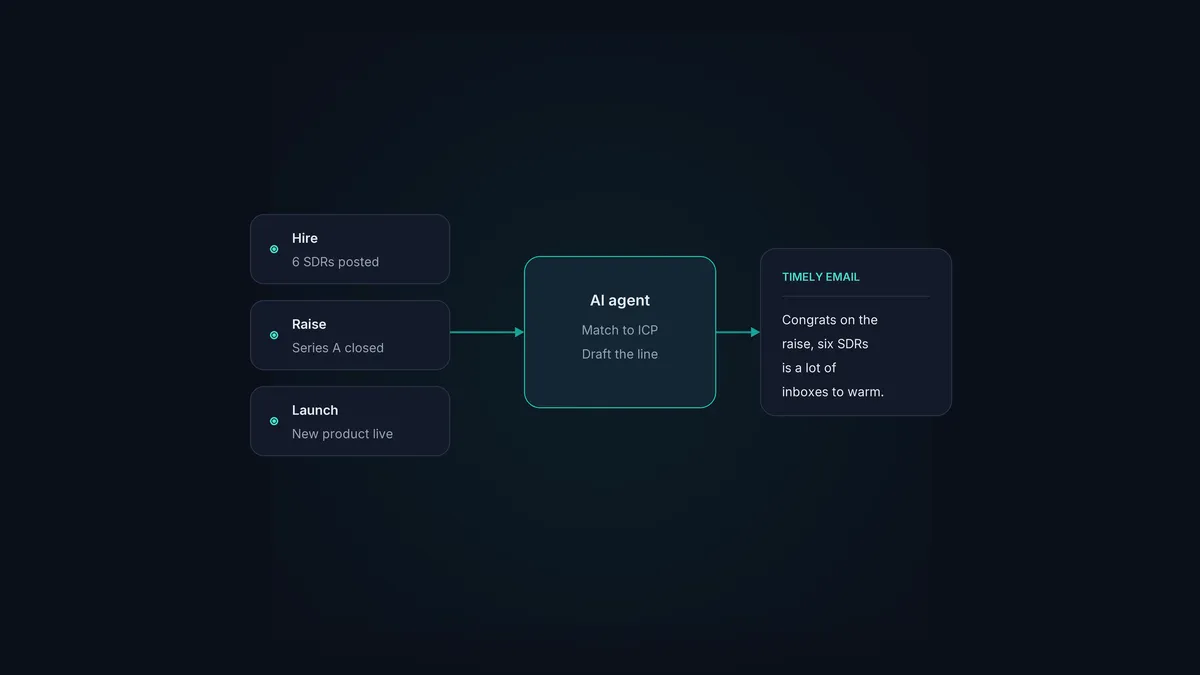
Most cold email goes out on the calendar: you bought a list, so now you email it. Signal-based outbound flips that round. You reach a prospect because something just changed at their company, a hire, a funding round, a product launch, a new tool in their stack, and the message is timed to that change. The reply-rate gap between the two isn’t small, because relevance and timing do most of the work in cold email.
AI agents are what make signal-based outbound practical at scale. Here’s the playbook: what a signal is, how agents act on it, and how to run it without it turning into faster spam.
The short version
- Signal-based outbound reaches prospects when a relevant event happens, not on a static list.
- A signal is a real, recent change: a hire, a raise, a launch, a tech-stack move.
- AI agents watch for signals, draft the timely message, and queue it for sending.
- The signal has to connect to your offer, or it's just a fancier excuse to email.
- Keep a human on the judgement; let the agent handle the watching and drafting.
What counts as a signal
A signal is a recent, specific change that makes your outreach relevant right now. The good ones share a shape: they’re timely, they’re real, and they connect to a problem you solve.
- Hiring signals. A company posting for SDRs or RevOps is scaling outbound, which means more inboxes to warm and more campaigns to run.
- Funding signals. A raise usually means a growth target and the budget to chase it.
- Product or launch signals. A new product means a new audience to reach.
- Tech-stack signals. Picking up or dropping a tool tells you what they’re wrestling with.
What doesn’t count: a generic “I see you’re in SaaS”. That’s not a signal, it’s a category. A real signal is something that happened, on a date, that you can name. If you can’t point to the event, you haven’t got one.
How AI agents fit
The reason signal-based outbound used to be a luxury is that watching for signals by hand doesn’t scale. A rep can deeply research ten accounts a day, not a thousand. AI agents change the maths on the watching and the drafting, the two parts that ate all the time.
An agent can monitor sources for the triggers you care about, match them to accounts in your ideal customer profile, and draft a message that references the specific event. What you get back is a queue of timely, relevant outreach with a real reason behind each one, instead of a static list emailed on schedule.
The drafting matters as much as the watching. A signal with a generic email wastes the signal. This is exactly the AI personalisation job: one line that proves you noticed the event, on top of a clear message about why it matters to them.
The playbook, step by step
- Pick signals that map to your offer. Start from the problem you solve and work backwards to the events that create it. Two or three strong signals beat ten weak ones.
- Tie each signal to your ICP. A trigger only matters at a company that fits. Filter the signal through your ICP so the agent doesn’t chase events at accounts you’d never sell to.
- Let the agent watch and draft. Have it surface matching signals and draft the timely message, with the specific event referenced and a clear reason to care.
- Keep a human on approval. Review the drafts and the timing. The agent handles volume; you handle judgement, especially early on, while you’re learning which signals actually convert.
- Send through a real cold email backbone. Timely outreach still needs warmup, inbox rotation and sensible volume, or you burn domains faster than ever.
Running it without burning domains
Signal-based outbound can quietly bump up your volume and spread it across more domains, which makes the deliverability fundamentals matter more, not less. The whole point is relevance, and nothing kills relevance like a message that never reaches the inbox because the domain’s cooked.
This is where the backbone earns its keep. With HotHawk, the agent side can run through Claude over the MCP server, drafting and queuing the signal-based outreach, while HotHawk handles warmup, inbox rotation and the master inbox that catches the replies. The agent does the watching and writing; the platform makes sure it reaches someone. For the wider view on how much to automate, see the AI SDR vs AI sequencer guide.
Act on signals, keep deliverability
Let Claude watch for signals and draft the timely message over HotHawk's MCP server, while HotHawk handles warmup, rotation and every reply underneath.
See AI and Claude workflowsA few common questions
What is signal-based outbound? Reaching prospects because of a recent, relevant change at their company, a hire, a raise, a launch, rather than emailing a static list on schedule. The message is timed to the event, which lifts relevance and reply rates.
How do AI agents help with signal-based outbound? They monitor sources for the triggers you care about, match them to accounts that fit your ICP, and draft timely outreach that references the specific event. They scale the watching and drafting a human can’t do across thousands of accounts.
Is signal-based outbound just personalisation? It’s the timing layer on top of personalisation. The signal decides when and why to reach out; personalisation writes the line that proves you noticed. Together they make outreach feel addressed rather than processed.
Signal-based outbound is the most reliable way to lift cold email reply rates, because it fixes the two things that decide them: relevance and timing. Use AI agents to watch and draft at scale, keep a human on the judgement, and send through a backbone that actually reaches the inbox.
