How to Build an Ideal Customer Profile for B2B Outbound (With Template)
HotHawk is cold email software for serious outbound teams.
Special offer
Get 50% more sending, FREE.
50% extra sending on any plan, every month.
On this page
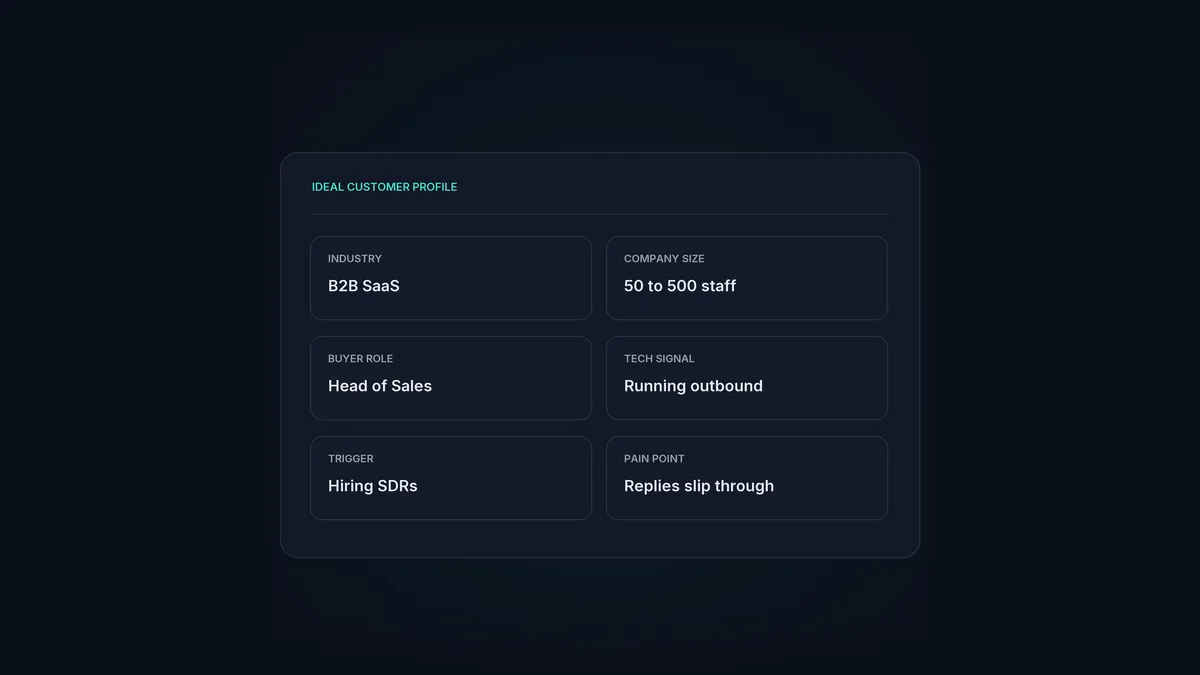
An ideal customer profile, or ICP, is a precise description of the type of company you sell to best: the ones who buy fastest, stay longest, and get the most value. It is the single most important input into outbound, because it decides who you reach out to, and no amount of clever copy fixes a list of the wrong people.
Most underperforming outbound is not a messaging problem. It is an ICP problem. Here is how to build one that actually sharpens your targeting, with a template you can fill in today.
The short version
- An ICP describes the company you sell to best, not an individual buyer.
- It sets the ceiling on outbound: the right list beats the right words every time.
- Build it from your best existing customers, not from wishful thinking.
- Cover firmographics, technographics, triggers, and the specific pain you solve.
- Keep it tight. A vague ICP that fits everyone targets no one.
ICP vs buyer persona
These two get confused, so let us be clear:
- An ICP describes the company: industry, size, location, tech stack, and situation. It answers “which organisations should we target?”
- A buyer persona describes the person inside that company: their role, goals and objections. It answers “who do we talk to, and how?”
You need both, but the ICP comes first. You pick the right companies, then work out who to reach inside them. This guide is about the company-level ICP.
Why the ICP sets the ceiling
Everything downstream in outbound, your reply rate, your meeting rate, your close rate, is capped by who is on your list. A perfect email to the wrong company gets ignored; an average email to exactly the right company gets a reply. The list is the single biggest lever you have, and the ICP is what builds the list.
This is why teams that obsess over subject lines while targeting a sloppy, too-broad list keep losing to teams with mediocre copy and a razor-sharp ICP. Get this right and everything else gets easier.
The attributes that make up an ICP
A useful ICP covers four layers:
- Firmographics. The basics: industry, company size (headcount or revenue), and geography. These are your hard filters.
- Technographics. The tools they use. Running a particular CRM, sender, or stack often signals fit, because it tells you how they operate.
- Triggers. The situations that make them relevant now: hiring SDRs, raising funding, launching a product, scaling outbound. Triggers turn a static list into a timely one.
- Pain points. The specific problem you solve for them. If you cannot name the pain, you cannot write outreach that resonates, and you probably have not narrowed the ICP enough.
The trigger and pain layers are where most ICPs are too thin. Firmographics get you a list; triggers and pain get you a reason to reach out that the prospect will recognise.
A simple ICP template
Fill this in, and keep it to one company type per profile:
- Industry: the specific vertical, not “B2B”.
- Company size: a headcount or revenue band.
- Geography: the regions you can actually serve and sell to.
- Tech / operating signal: tools or behaviours that indicate fit.
- Trigger: the situation that makes them relevant now.
- Pain point: the specific problem you solve, in their words.
- Disqualifiers: who looks like a fit but is not, so you can filter them out.
If your answers feel like they could describe almost any company, the ICP is too broad. Tighten it until it excludes most of the market, because the point of an ICP is to say no to the wrong prospects as much as yes to the right ones.
Putting the ICP to work
A sharp ICP feeds directly into the rest of the outbound motion. It tells your lead generation exactly who to source, it gives your reps the relevance to write outreach that resonates, and it stops you wasting sends on companies that were never going to buy. If you use a lead gen company, the ICP is the brief you hand them, and a vague brief gets you a vague list.
Once the ICP is right and the list is built, the job is execution: reach the right people reliably, and catch every reply. That is where the email sequencer and reply inbox take over, and where the outbound sales playbook picks up.
Point your outbound at the right accounts
A sharp ICP plus HotHawk's email sequencer means your outreach reaches the right people and every reply arrives in one inbox. Targeting and execution, working together.
Start your 7 day free trialA few common questions
What is an ideal customer profile? A precise description of the company you sell to best: industry, size, location, tech, trigger and pain. It decides who you target in outbound.
What is the difference between an ICP and a buyer persona? An ICP describes the company; a buyer persona describes the person inside it. You pick the right companies with the ICP, then decide who to reach with the persona.
How specific should an ICP be? Specific enough to exclude most of the market. If it could describe almost any company, it is too broad to be useful. Build it from your best existing customers.
Your ideal customer profile is the foundation everything else in outbound is built on. Define it from your best customers, cover the firmographics, the triggers and the pain you solve, and keep it tight enough to say no. Get the ICP right and the right list, the right replies, and the right meetings follow.
