Cold Email Follow-Up: The Complete Guide to Getting More Replies
HotHawk is cold email software for serious outbound teams.
Special offer
Get 50% more sending, FREE.
50% extra sending on any plan, every month.
On this page
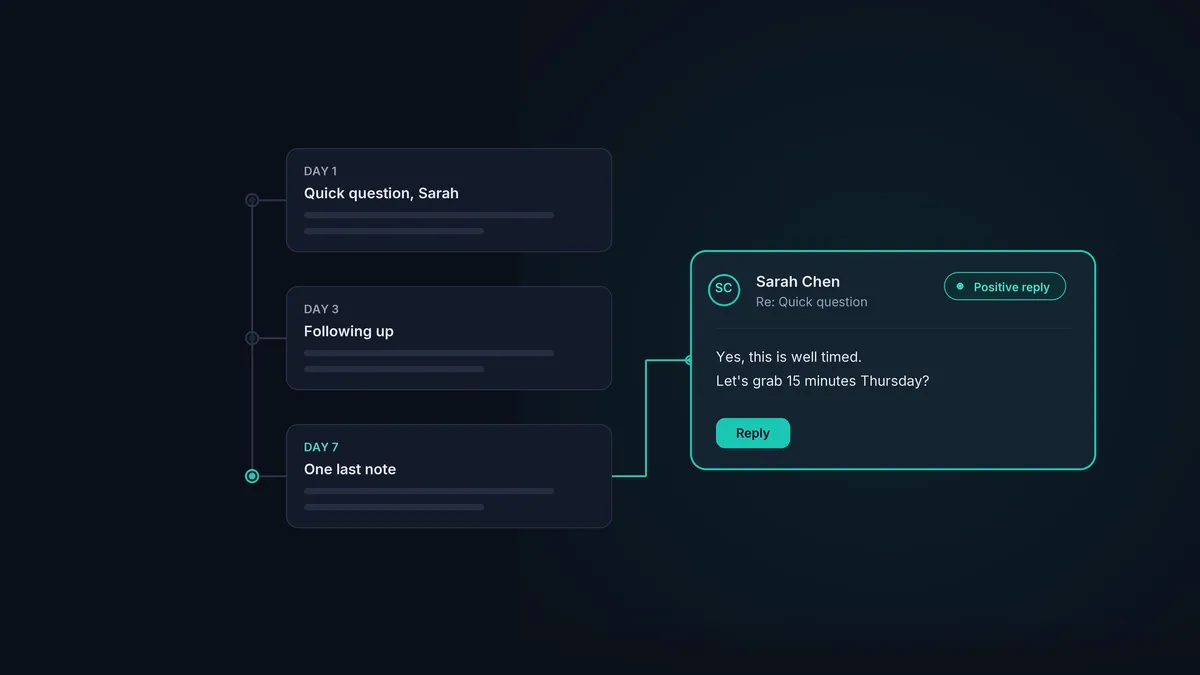
Most of the replies you will ever get from cold email do not come from the first email. They come from the second, the third, and sometimes the fourth. If you send one email and move on, you are throwing away the majority of your results before they have had a chance to show up.
That is the whole case for following up. Not persistence for its own sake, but the simple fact that inboxes are busy and timing is luck. The person who ignored you on Monday because they were in back-to-back meetings is a different person on Thursday morning with a coffee and a clear calendar. The follow-up is how you catch them on the good day.
This guide covers how many follow-ups to send, how to space them, what to write in each one, and the part most people get wrong: knowing when to stop.
The short version
- Send 2 to 4 follow-ups. Stopping at one leaves most of your replies on the table; going past five mostly annoys people.
- Space them out: roughly day 3, day 6, then a week. Tight gaps read as desperate, long gaps lose the thread.
- Make every follow-up add something new: a fresh angle, a proof point, or a smaller ask. A bare 'bumping this' just teaches people to skip you.
- Keep follow-ups on the same thread so context carries, and stop the moment someone replies.
- The break-up email is often the best performer. Give people an easy door out and some take the meeting instead.
Why follow-ups get more replies than the first email
A cold email arrives in an inbox that already holds forty unread messages. Yours is competing with the boss, the customer, the calendar invite and the newsletter. Even a good email from a relevant sender gets skimmed and left for later, and later never comes.
None of that is a rejection. It is just attention. The follow-up works because it gives your message a second and third shot at a moment when the person actually has the headspace to read it and act. (New to this? Start with what a follow-up email is.)
There is a second reason that matters more than people admit: a follow-up signals that you are serious. A one-and-done email looks like a blast. Someone who writes again, briefly and politely, looks like a person with a real reason to be in touch. That small shift in perception is often the difference between a reply and silence.
The goal is not to wear someone down. It is to stay gently present until you hit a day when what you are offering happens to be on their mind.
How many follow-ups should you send
The honest answer is two to four after the first email, so three to five touches in total. The data behind that sits in how many cold email follow-ups to send.
Stop at one and you are leaving most of your replies unclaimed. Push past five or six and you cross from helpful to irritating, your reply rate flattens, and you start collecting unsubscribes and spam complaints that hurt the rest of your campaign.
Where you fall inside that range depends on the offer:
- Higher value, considered purchase (you are selling to a small, defined list and each account is worth a lot): four or five touches are justified. These buyers expect a bit of pursuit and forget quickly.
- Lower value, high volume (you are reaching a wide audience with a lighter offer): two or three touches are plenty. The list is big enough that you are better off moving on than squeezing a cold lead.
A useful test: if you would feel comfortable sending the next email to a warm contact you respect, send it. The moment a follow-up would make you wince in a normal relationship, you have gone one too far.
How long to wait between follow-ups
Timing is where good intentions go wrong. People either fire follow-ups a day apart and look frantic, or leave three weeks and lose the thread entirely.
A spacing that works in practice:
- First email - day 0
- Follow-up 1 - day 3
- Follow-up 2 - day 6 or 7
- Follow-up 3 - day 12 to 14
- Break-up email - day 18 to 21
The pattern is deliberate. Early follow-ups sit close together while the first email is still fresh, then the gaps widen so you fade into the background rather than nagging. Widening the interval also quietly respects the reader: it says you are around, not camped on their doorstep.
Send in their working hours, in their time zone, and avoid Monday mornings and Friday afternoons where you can. A Tuesday to Thursday mid-morning send tends to catch people at a desk rather than buried or already gone for the weekend.
What to say in each follow-up
A follow-up that says nothing but “just bumping this to the top of your inbox” teaches the reader that you have nothing to add. Every touch should earn its place by bringing something new. You do not need a fresh essay each time. You need one fresh reason to reply.
Here is a structure that holds up across most campaigns.
Follow-up 1: a new angle
Do not repeat the first email. Lead with a different benefit or a different entry point into the same problem. If the first email led on saving time, this one leads on the cost of the status quo. Keep it shorter than the original.
Follow-up 2: proof
This is the place for a specific, relevant result. A named outcome from a similar company, a number you can stand behind, a short case in one sentence. Proof does the persuading that adjectives cannot. Vague claims read as noise, so be concrete or leave it out.
Follow-up 3: make the ask smaller
If you still have not booked a meeting, lower the bar. Instead of “do you have 30 minutes”, try “is this even a priority this quarter, yes or no?” or “want me to send a two minute video instead?”. A smaller ask is easier to say yes to, and a one-word reply still reopens the conversation.
The break-up: give them the exit
More on this below, because it deserves its own section. In short, you tell them this is the last email and you make leaving easy. Done well, it is frequently the highest-replying message in the whole campaign.
Stop writing every follow-up by hand
HotHawk sends your follow-ups automatically, on your schedule, and pauses the moment someone replies so nobody gets chased after they have answered.
Start your 7 day free trialFollow-up subject lines
Because your follow-ups should sit on the original thread, the subject line mostly takes care of itself: it stays the same, with a “Re:” in front, and that consistency is part of why threading works.
When you do want a fresh subject, for the break-up email or a re-engagement after a long gap, keep it short and human:
- “Should I close this out?”
- “Bad timing?”
- “One last idea, [First name]”
- “Worth a quick look?”
Avoid anything that fakes urgency or pretends to be a reply when it is not. “RE: our conversation” when there was no conversation is the kind of trick that gets you marked as spam and burns the trust you are trying to build.
The break-up email
The break-up email is the message where you tell someone you will stop emailing them. It works for two reasons. People dislike a door closing, so some reply simply because the chance is about to disappear. And it is genuinely respectful, which makes the rare reply a warmer one.
A break-up email that performs tends to do three things. It is honest that this is the last touch. It keeps the ask tiny. And it leaves zero pressure, which is exactly what makes people comfortable enough to answer.
Hi [First name],
I have reached out a couple of times about [the thing] and not heard back, which usually means it is not a priority right now or I have caught you at a bad moment. Either is completely fine.
I will leave it here so I am not cluttering your inbox. If it is worth a look down the line, just reply and I will pick it straight back up.
All the best, [Your name]
The trick is to mean it. If “this is the last email” is a bluff and you keep going, you train people to ignore you. Stop when you say you will stop.
Managing follow-ups at scale without being annoying
Everything above is easy with ten prospects and a spreadsheet. It falls apart at a thousand. The two failures that do the most damage are both about replies, and both are avoidable.
The first is chasing someone who has already answered. A prospect replies “yes, interested”, and two days later your automated follow-up 3 arrives telling them you have not heard back. It is a small thing that makes you look like you are not paying attention, and it is entirely a tooling problem. A good email sequencer detects the reply and pauses that contact automatically, so a human conversation never collides with the campaign.
The second is the reply that nobody sees. At scale you are sending from several mailboxes, and replies do not all come back where you expect. Some arrive as forwards. Some come from a colleague who got CC’d. Some come from a decision-maker you never emailed directly. If your replies are scattered across inboxes, the good ones go cold while everyone assumes someone else has them.
This is the job HotHawk was built for. Reply detection pauses follow-ups the instant someone responds, and every reply across every mailbox, including the forwarded and CC’d ones, is captured in one reply management inbox. From there it is auto-categorised and routed to the right rep straight away. The follow-up engine keeps the campaign moving, and the inbox makes sure no answer gets lost while it does. The reason this matters so much: speed to reply is what turns a positive reply into a meeting.
Follow-up mistakes that kill reply rates
A few patterns show up again and again in campaigns that under-perform:
- “Bumping this” with nothing added. If the email has no new reason to reply, it teaches the reader to skip you. Add an angle or do not send it.
- Guilt-tripping. “I have emailed three times and still nothing” makes the reader the villain. Stay light and assume good intent, every time.
- Sending too fast. Three emails in four days reads as desperate. Give the gaps room.
- Never stopping. Follow-up number seven does not win the deal. It wins a spam complaint that drags down deliverability for everyone else on the domain.
- Breaking the thread. A fresh email each time strips the context and makes you look like a machine. Reply on the original.
- One generic line for everyone. The follow-up is a second chance to be relevant. Reference something true about them, even if it is just their role or their market.
Templates you can adapt
Treat these as scaffolding, not scripts. Swap in something specific to the person, or they become the generic bumps you are trying to avoid. For a fuller set covering every scenario, see the cold email follow-up templates, the dedicated guide to following up after no response, and how to handle a follow-up after a cold call.
Follow-up 1, new angle (day 3):
Hi [First name], one more thought on [problem]. The teams we speak to usually lose the most time on [specific symptom] rather than [the obvious thing]. Is that true for you, or are you already on top of it?
Follow-up 2, proof (day 7):
Hi [First name], quick one. [Similar company] had the same issue with [problem] and got [specific result] within [timeframe]. Happy to walk you through how, if it is useful. Worth 15 minutes?
Follow-up 3, smaller ask (day 13):
Hi [First name], I do not want to keep filling your inbox. Simple question: is [problem] something you are looking at this quarter, yes or no? If not, I will happily park it.
Break-up (day 20):
Hi [First name], I will close this out as I have not heard back, which usually just means the timing is off. If it becomes relevant later, reply to this and I will pick it straight back up. All the best.
A few common questions
Is it rude to follow up on a cold email? No, as long as you stay brief, polite and useful, and you stop when asked. A short, relevant follow-up is normal professional behaviour. What reads as rude is volume without value: many emails, close together, that add nothing.
How long should I wait before the first follow-up? Around three days. Long enough that you are not on top of the first email, short enough that it is still fresh.
Should follow-ups be shorter than the first email? Usually, yes. The first email sets up the context. Each follow-up only needs to add one new reason to reply, so it can be a couple of lines.
When should I stop? After the break-up email, or the moment someone asks you to. Past that, the cost to your domain reputation outweighs any reply you might squeeze out.
Follow-ups are not the unglamorous afterthought of cold email. They are where most of the results actually live. Get the count, the timing and the content right, make sure a real reply never slips through, and the same list that felt dead after one email starts to give you meetings.
