Cold Email Follow-Up Templates That Actually Book Meetings
HotHawk is cold email software for serious outbound teams.
Special offer
Get 50% more sending, FREE.
50% extra sending on any plan, every month.
On this page
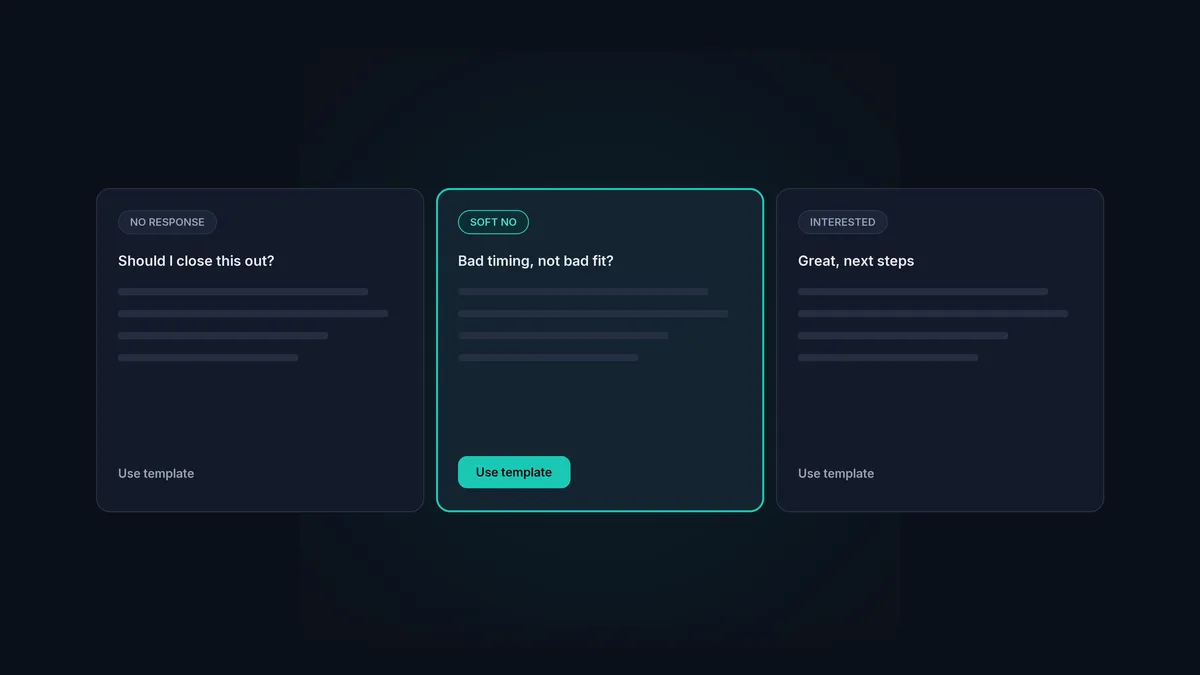
A good follow-up template saves you time. A bad one costs you replies, because the reader can smell a paste job from the subject line. The trick is to treat these as scaffolding: keep the structure, swap in something true about the person, and the template does its job without sounding like one.
Below are templates for the scenarios you actually hit in cold outreach, grouped by what is going on. Each one comes with the reason it works, so you can adapt it rather than copy it blind.
The short version
- Match the template to the situation. A no-response nudge and a reply to a soft no are different jobs.
- Every follow-up needs one fresh reason to reply: a new angle, a proof point, or a smaller ask.
- Keep them short and on the original thread, so the context carries.
- Personalise one real detail per send. That single line is what stops it reading as a blast.
- Always make the next step tiny and easy to say yes to.
Templates for no response
This is the most common case: you sent a good email and heard nothing. For the full timing and strategy, see the cold email follow up guide; for more on this exact scenario, the no-response follow-up guide goes deeper.
The light nudge
Why it works: it assumes good intent and gives a low-pressure second chance.
Hi [First name], I know inboxes get busy, so I am floating this back up. The teams we work with usually lose the most time on [specific problem]. Is that on your radar, or have you got it covered?
The value-add
Why it works: it gives something useful whether or not they reply, which earns attention without asking for anything.
Hi [First name], no worries if the timing is off. In case it helps, here is [a relevant benchmark or quick idea] that [similar companies] use to [outcome]. Happy to talk it through if it is ever useful.
The proof point
Why it works: one specific, relevant result persuades where adjectives cannot.
Hi [First name], quick one. [Similar company] had the same issue with [problem] and got [specific result] in [timeframe]. If that is interesting, I would happily show you how. Worth 15 minutes?
Templates for a soft no
A soft no is “not right now”, “we are not looking at this”, or “maybe later”. It is not a door closing. It is a door on the latch.
Acknowledge and park
Why it works: respecting the no makes you the rare sender they remember warmly.
Hi [First name], completely understand, thanks for letting me know. I will check back in a quarter or so in case things change. If anything shifts sooner, you know where I am.
The light reframe
Why it works: it gently tests whether the no is about timing or about fit, without pushing.
Hi [First name], fair enough. Out of interest, is it that [problem] is not a priority right now, or that you have it handled another way? Either is genuinely fine, it just helps me know whether to check back later.
Templates for out of office
An out-of-office reply is a gift. You now know exactly when they are back.
The return nudge
Why it works: it arrives when they are clearing the backlog, with zero pressure.
Hi [First name], hope you had a good break. I will not pile onto the first-day-back inbox, so just flagging my note from last week on [problem] in case it is useful now you are back in the swing of things.
Templates for interested replies
When someone bites, speed and simplicity win. Do not make an interested person fill in a form or chase a calendar link twice.
The easy next step
Why it works: it removes friction by offering concrete times rather than “let me know your availability”.
Hi [First name], great to hear. Would Thursday at 2pm or Friday at 11am work for a quick 15 minutes? If neither suits, send a couple of windows and I will fit around you.
The wrong-person handoff
Why it works: it makes a referral effortless, which is how you reach the real decision-maker.
Hi [First name], thanks for the steer. Rather than put you in the middle, would it be easier if I reached out to [colleague] directly? Happy to copy you in or leave you out of it, whichever you prefer.
The break-up template
The last email, and often the highest-replying one. People dislike a closing door, and a polite exit makes the rare reply a warm one.
Hi [First name], I will close this out as I have not heard back, which usually just means the timing is off. If it becomes relevant later, reply to this and I will pick it straight back up. All the best.
Make the templates actually work at scale
Templates get you the reply. The risk is what happens next. When you are sending follow-ups from several mailboxes, the answers come back in different places: a forward here, a CC there, a reply to a mailbox you forgot you were sending from. Good replies go cold because nobody saw them.
HotHawk pulls every reply into one reply management inbox and pauses the follow-ups for anyone who answers, so the template that earned the reply is never undone by a follow-up that should have stopped.
Send the follow-up, catch the reply
HotHawk runs your follow-ups and captures every reply in one inbox, then pauses the chase the second someone answers.
Start your 7 day free trialHow to adapt a template without breaking it
Three rules keep a template human:
- Change the opener. The first line is where a paste job shows. Lead with something specific to them.
- Keep one idea per email. A follow-up needs one reason to reply, not five. Cut the rest.
- Shorten as you go. Each follow-up should be a little tighter than the last. By the break-up, you are down to a few lines.
Treat the templates here as a starting point, not a script. Match the scenario, add the one true detail, keep the ask small, and the same outreach that used to go quiet starts booking meetings.
