How to Write a Follow-Up Email After No Response
HotHawk is cold email software for serious outbound teams.
Special offer
Get 50% more sending, FREE.
50% extra sending on any plan, every month.
On this page
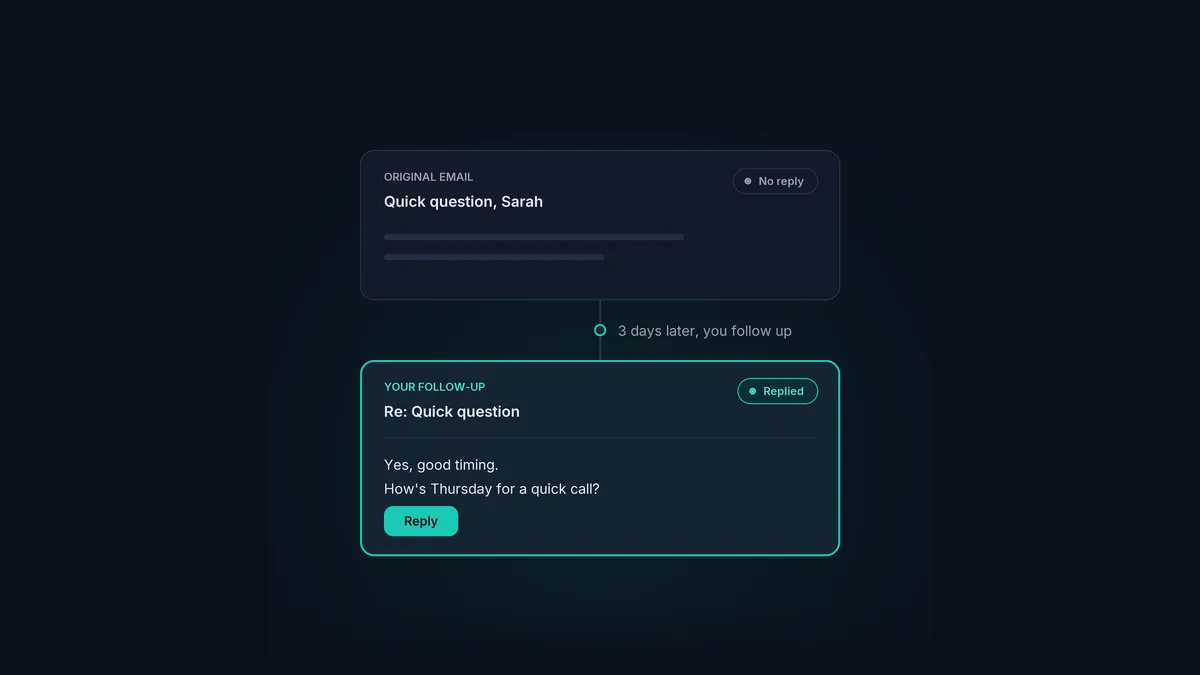
Silence after a cold email feels personal. It almost never is. The person was busy, your message arrived at a bad moment, or it slipped down the inbox before they got to it. None of that is a no. It is just a missed moment, and the follow-up is how you catch a better one.
The numbers back this up: most positive replies to cold email come from a follow-up, not the first send. So the email you write after no response is not an afterthought. It is where most of the results actually come from.
Here is exactly what to send, when to send it, and the templates to adapt.
The short version
- No reply usually means bad timing, not rejection. Treat it that way and your follow-ups stay warm.
- Wait about 3 days after the first email, then space later follow-ups wider.
- Every follow-up needs a fresh reason to reply: a new angle, a proof point, or a smaller ask.
- Keep it on the same thread so the context carries and you are not starting from scratch.
- Stop after a polite break-up email. Chasing past that costs you more than it returns.
Why no response usually is not rejection
A decision-maker opens dozens of emails a day and acts on a handful. Yours can be relevant and well written and still get parked for later, and later quietly never arrives. That is not a verdict on your offer. It is the inbox doing what inboxes do.
This matters because it changes how you write the next email. If you assume rejection, your follow-up comes out either apologetic or pushy. If you assume bad timing, which is far more likely, you write something light and useful that gives them an easy second chance to say yes. Same situation, completely different email.
How long to wait before following up
Around three working days after the first email. That is long enough that you are not sitting on top of them, short enough that the original is still fresh.
After that, widen the gaps:
- First email - day 0
- Follow-up 1 - day 3
- Follow-up 2 - day 7
- Follow-up 3 - day 12 to 14
- Break-up email - day 18 to 21
Send in their working hours and their time zone. A Tuesday-to-Thursday mid-morning send tends to catch people at a desk rather than buried under a Monday backlog or already gone for the weekend. For the full timing logic, see the cold email follow up guide.
Follow-up email templates for no response
Treat these as scaffolding. Drop in something true about the person, or they become the generic “just bumping this” emails everyone ignores.
1. The light nudge (first follow-up)
Short, friendly, and leads with a slightly different angle than the first email.
Hi [First name], I know inboxes get busy, so I wanted to float this back up. The teams we work with usually lose the most time on [specific problem]. Is that on your radar at the moment, or have you got it handled?
2. The value-add
Give them something useful whether or not they reply. It earns attention without asking for anything.
Hi [First name], no worries if the timing is off. In case it is useful, here is [a relevant resource, benchmark, or quick idea] that [similar companies] have used to [outcome]. Happy to talk it through if you ever want to.
3. The proof point
One specific, relevant result does the persuading that adjectives cannot.
Hi [First name], quick one. [Similar company] had the same issue with [problem] and got [specific result] in [timeframe]. If that is the kind of outcome you are after, I would happily show you how. Worth 15 minutes?
4. The smaller ask
If a meeting has not happened, lower the bar so a reply costs them almost nothing.
Hi [First name], rather than keep filling your inbox, one simple question: is [problem] something you are looking at this quarter, yes or no? If not, I will happily park it.
5. The break-up
The last email, and often the best performer. People dislike a closing door, and some reply purely because the chance is about to go.
Hi [First name], I will close this out as I have not heard back, which usually just means the timing is not right. If it becomes relevant later, reply to this and I will pick it straight back up. All the best.
Subject lines for a no-response follow-up
Because your follow-ups should sit on the original thread, the subject mostly looks after itself: it stays the same with a “Re:” in front, and that consistency is part of why it works.
When you do want a fresh subject, for a break-up or a re-engagement after a long gap, keep it short and human:
- “Should I close this out?”
- “Bad timing, [First name]?”
- “One last idea”
- “Still worth a look?”
Avoid anything that fakes a prior conversation. “RE: our chat” when there was no chat reads as a trick and gets you marked as spam, which hurts every other email you send from that domain.
How many times to follow up before stopping
Two to four follow-ups after the first email, so three to five touches in total. Stop at one and you leave most of your replies unclaimed. Push past five or six and you start collecting unsubscribes and spam complaints that drag down your domain.
When you reach the break-up email, mean it. If “this is the last email” is a bluff and you keep going, you train people to ignore you. Stop when you say you will.
Make sure the reply never gets missed
There is a quieter way to lose a deal here, and it has nothing to do with what you write. You send the follow-ups, someone finally replies, and the reply gets missed. It comes back to a different mailbox, or as a forward, or from a colleague who was looped in, and it sits unread while you assume the lead went cold.
When you are sending from several mailboxes, this happens more than people think. HotHawk pulls every reply across every mailbox, including the forwarded and CC’d ones, into one reply management inbox, and pauses the follow-ups for anyone who answers. The chasing stops the moment it should, and no reply slips through while you wait.
Never miss the reply your follow-up earns
HotHawk catches every reply across every mailbox in one inbox and pauses follow-ups the moment someone answers, so a real reply always reaches a real person.
Start your 7 day free trialA few common questions
How long should I wait before following up on no response? About three working days for the first follow-up. Wider gaps after that, up to a couple of weeks before the final email.
Is it rude to follow up when someone has not replied? No, as long as you stay brief, useful, and polite, and you stop when asked. Most people expect a follow-up or two and do not mind them.
What is the best follow-up email after no response? The one that adds a new reason to reply rather than just nudging. A light angle change, a relevant result, or a smaller ask all beat “just checking in”.
No response is rarely the end of the conversation. It is usually the middle of it. Send a couple of warm, useful follow-ups on the right timing, make sure the reply gets seen when it comes, and a quiet list starts to answer.
