How Many Follow-Ups Should You Send on a Cold Email?
HotHawk is cold email software for serious outbound teams.
Special offer
Get 50% more sending, FREE.
50% extra sending on any plan, every month.
On this page
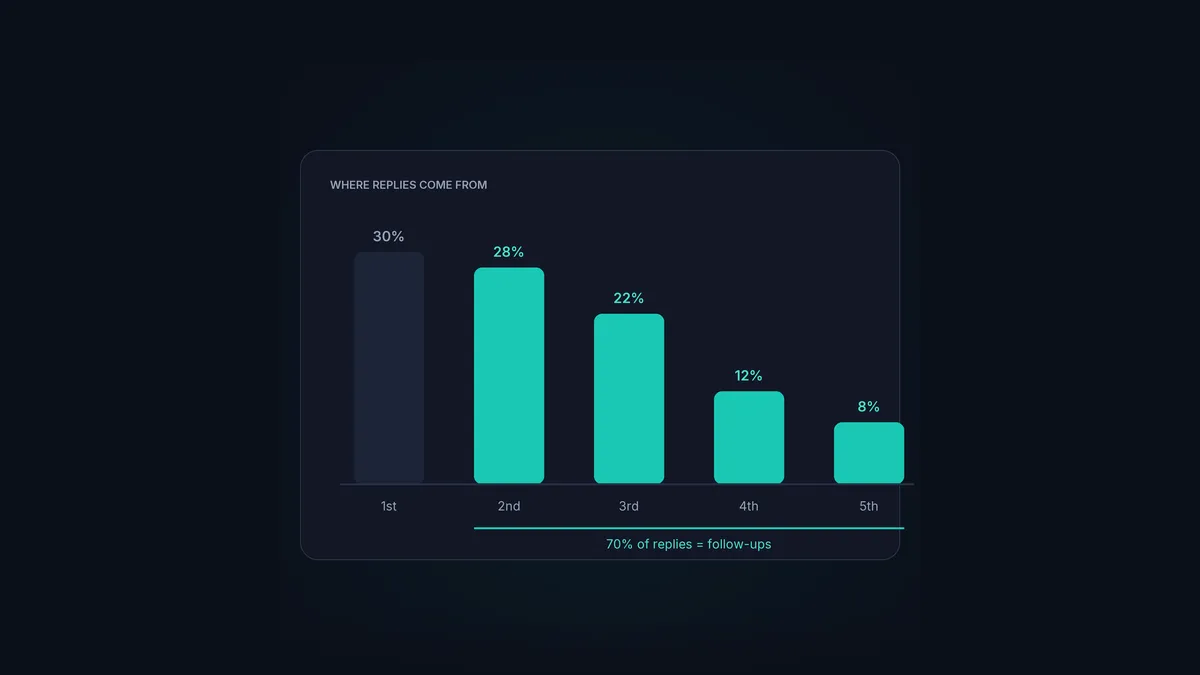
The short answer: send two to four follow-ups after the first email, so three to five touches in total. Stop at one and you leave most of your replies on the table. Push past five or six and you start doing more harm than good.
The reason is in where replies actually come from. The first email gets a slice of them, but the bulk arrive on the second and third touch, once you have caught the reader on a better day. A campaign that gives up after one send is quitting right before the part that works.
Where cold email replies really come from
If you tag replies by which email triggered them, the pattern is consistent: the first email brings in a meaningful share, then the next two touches pull in roughly as many again between them, and the returns taper off from there.
The takeaway is not “send more forever”. It is that the early follow-ups are where most of your unclaimed replies are hiding, and skipping them throws away results you have already half-earned. For the full strategy behind this, see the cold email follow up guide.
How many is right for your campaign
Two to four follow-ups is the band that works for most outreach. Where you sit inside it depends on the offer:
- High-value, small list. When each account is worth a lot and the list is tight, four or five touches are justified. These buyers expect some pursuit and forget quickly.
- Lower-value, big list. When you are reaching a wide audience with a lighter offer, two or three touches are plenty. The list is big enough that moving on beats squeezing a cold lead.
A simple gut check: if you would feel fine sending the next email to a warm contact you respect, send it. The moment a follow-up would make you wince in a normal relationship, you have gone one too far.
How to space them
Count matters less if the timing is wrong. A workable rhythm:
- First email - day 0
- Follow-up 1 - day 3
- Follow-up 2 - day 7
- Follow-up 3 - day 12 to 14
- Break-up email - day 18 to 21
Early follow-ups sit close together while the first email is fresh, then the gaps widen so you fade into the background rather than nagging.
When sending more starts to backfire
There is a hard ceiling, and it is not about politeness. It is about deliverability.
Every email that gets ignored, deleted unread, or marked as spam is a small negative signal to the mailbox providers. Stack up enough of them by hammering a cold list with touch six, seven and eight, and your domain reputation drops. The damage spreads: it drags down inbox placement for every other email you send from that domain, including the ones that would have worked.
So one follow-up too many is a cost your whole programme pays, well beyond the single prospect you were chasing. That is why the break-up email matters: it gives you a clean, deliberate place to stop.
Stop properly with a break-up email
The last touch should tell the reader you are closing the loop, and then you actually close it.
Hi [First name], I will leave it here as I have not heard back, which usually just means the timing is off. If it becomes relevant later, reply to this and I will pick it straight back up. All the best.
If “this is the last email” is a bluff and you keep going, you train people to ignore you. Mean it.
Make every reply count
When you are sending several follow-ups across several mailboxes, the replies do not all come back where you expect, and the good ones go cold while everyone assumes someone else has them. Getting the count and timing right only pays off if you actually see and act on the replies it produces.
That is what a reply management inbox is for: it gathers every reply across every mailbox into one place and pauses the follow-ups for anyone who answers, so nobody gets chased after they have already said yes.
Send the right number, catch every reply
HotHawk runs your follow-ups on your schedule and captures every reply in one inbox, then stops the chase the moment someone responds.
Start your 7 day free trialA few common questions
How many follow-ups is too many? Past five or six on a cold list, the returns flatten and the spam complaints climb. End with a break-up email instead of pushing further.
Do follow-ups really get more replies than the first email? Yes. Across most cold outreach, the majority of replies come from follow-ups rather than the first send.
Should I stop as soon as someone opens but does not reply? No. An open is not a no. Keep to your planned touches and let the break-up email be the stopping point, unless they ask you to stop sooner.
The right number of follow-ups is enough to catch a better moment and no more: two to four after the first email, well spaced, each one earning its place, ending with a clean break-up. Get that right, make sure the replies get seen, and the same list starts giving you meetings.
