Domain Reputation for Cold Email: How to Build It, Monitor It, and Recover It
HotHawk is cold email software for serious outbound teams.
Special offer
Get 50% more sending, FREE.
50% extra sending on any plan, every month.
On this page
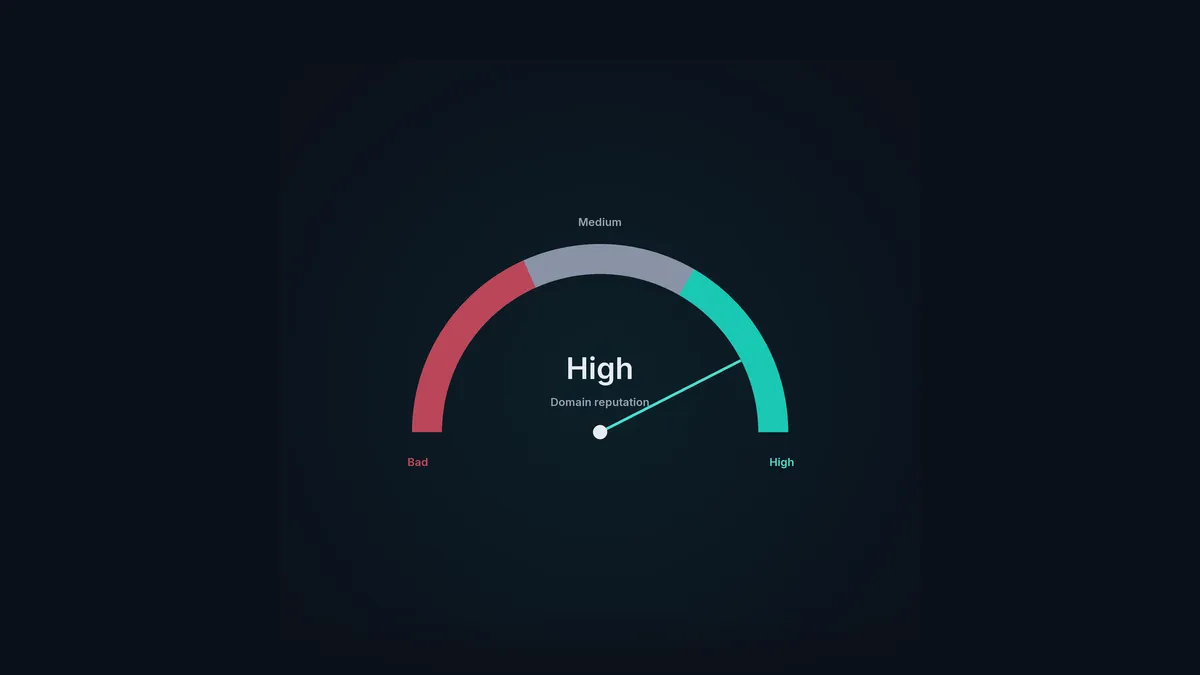
Domain reputation is the running score mailbox providers keep on how much they trust your sending domain. It’s built from your history: how much you send, how clean your list is, how people engage, and how often they hit the spam button. More than any single setting, it decides whether your cold email reaches the inbox, because providers lean on it to judge every message you send.
It works a lot like credit. Slow to build through good behaviour, trusted once it’s established, and a real pain to rebuild once it’s damaged. This guide covers how it’s scored, how to build it, how to keep an eye on it, and what to do when it drops.
The short version
- Domain reputation is a trust score providers build from your sending history.
- It's driven by volume patterns, bounce rates, spam complaints and engagement.
- Build it slowly with warmup and consistent, relevant sending.
- Watch it with Google Postmaster Tools and your own bounce and reply numbers.
- Recovering a damaged reputation is slow; protecting it is far cheaper.
What drives your reputation
Providers don’t publish their exact formulas, but the inputs are well understood. Your reputation rises and falls on:
- Sending volume and consistency. Steady, predictable volume builds trust. Sudden spikes from a cold domain look like a hijacked account or a spammer.
- Bounce rate. Email invalid addresses and you signal a list you don’t maintain, which is classic spammer behaviour. High bounces hurt fast.
- Spam complaints. When people mark you as spam, that’s the single strongest negative signal there is. Even a small complaint rate does real damage.
- Engagement. Opens, and especially replies, tell providers people want your email. Silence and instant deletes tell them the opposite.
- Authentication. Proper SPF, DKIM and DMARC are the baseline that lets any reputation stick to your domain in the first place.
No one input runs the show. A clean, well-authenticated domain that sends erratically to a dirty list will still slide.
How to build it
Building reputation is mostly patience and a handful of good habits:
- Warm up first. A new domain starts at zero, and warmup is how it earns a track record before your real campaigns begin. Skip it and you start in a hole.
- Ramp volume slowly. Climb gradually rather than going from zero to thousands. Let the reputation grow into the volume.
- Keep the list clean. Verify addresses, pull bounces straight away, and never mail scraped or stale data. Your bounce rate is reputation you control directly.
- Stay relevant. Engagement feeds your reputation, so a tight target and a real message do double duty: more replies and a stronger domain.
- Spread the load. Use inbox rotation so no single mailbox carries volume that spikes its risk.
How to monitor it
You can’t manage what you can’t see. The tools worth using:
- Google Postmaster Tools shows your Gmail domain reputation (High, Medium, Low, Bad), your spam complaint rate, and authentication results. If you send to any Gmail addresses, it’s the most useful free signal you’ve got.
- Your own numbers. Bounce rate, reply rate and complaint rate all move early. HotHawk’s analytics track human reply rate and bounces per campaign and across workspaces, and they shift before your placement does.
- Seed and placement tests. Check where your mail is actually arriving now and then, using the methods in how to test your email deliverability.
Watch the trend, not single readings. A reputation drifting from High to Medium over a week is your cue to act, well before it hits Bad.
How to recover a damaged reputation
If your reputation has dropped, you can bring it back, but it’s slow:
- Stop and diagnose. Pause the aggressive sending. Find the cause: a dirty list, a volume spike, a spam-trigger campaign, or a blacklisting.
- Fix the root cause. Clean the list, kill the offending campaign, sort out authentication. Recovery doesn’t start until the cause is gone.
- Re-warm and ramp gently. Treat the domain almost like a new one: rebuild trust with warmup and a slow, careful climb back to volume.
- Watch the signals. Use Postmaster Tools and your bounce and complaint rates to confirm the trend’s turning before you scale again.
In the worst cases, especially a blacklisted or properly burned domain, it can be quicker to move to a fresh domain and warm it properly than to nurse the old one back. That’s a last resort, and it only works if you fix whatever burned the first one.
Protect the asset, not just the campaign
HotHawk builds and protects domain reputation with native warmup on real inboxes, automatic inbox rotation, and analytics that flag bounces and reply drops early.
See how warmup worksA few common questions
What is domain reputation? A trust score mailbox providers give your sending domain based on its history: volume patterns, bounce rate, spam complaints, engagement and authentication. It’s the main thing deciding whether your cold email reaches the inbox.
How do I check my domain reputation? Google Postmaster Tools shows your Gmail domain reputation and spam rate for free. Pair it with your own bounce and reply numbers, which move before placement does, plus the odd placement test.
How long does it take to recover a damaged domain reputation? Weeks at best, longer if it was badly burned or blacklisted. Recovery means fixing the cause, re-warming, and ramping slowly. It’s slow enough that protecting your reputation is far cheaper than rebuilding it.
Domain reputation is the quiet number behind every campaign’s results. Build it patiently, watch it closely, and guard it like the asset it is. For how it fits with authentication, warmup and the rest, see the deliverability guide.
