Email Deliverability in 2026: What Changed and What It Means for Cold Email
HotHawk is cold email software for serious outbound teams.
Special offer
Get 50% more sending, FREE.
50% extra sending on any plan, every month.
On this page
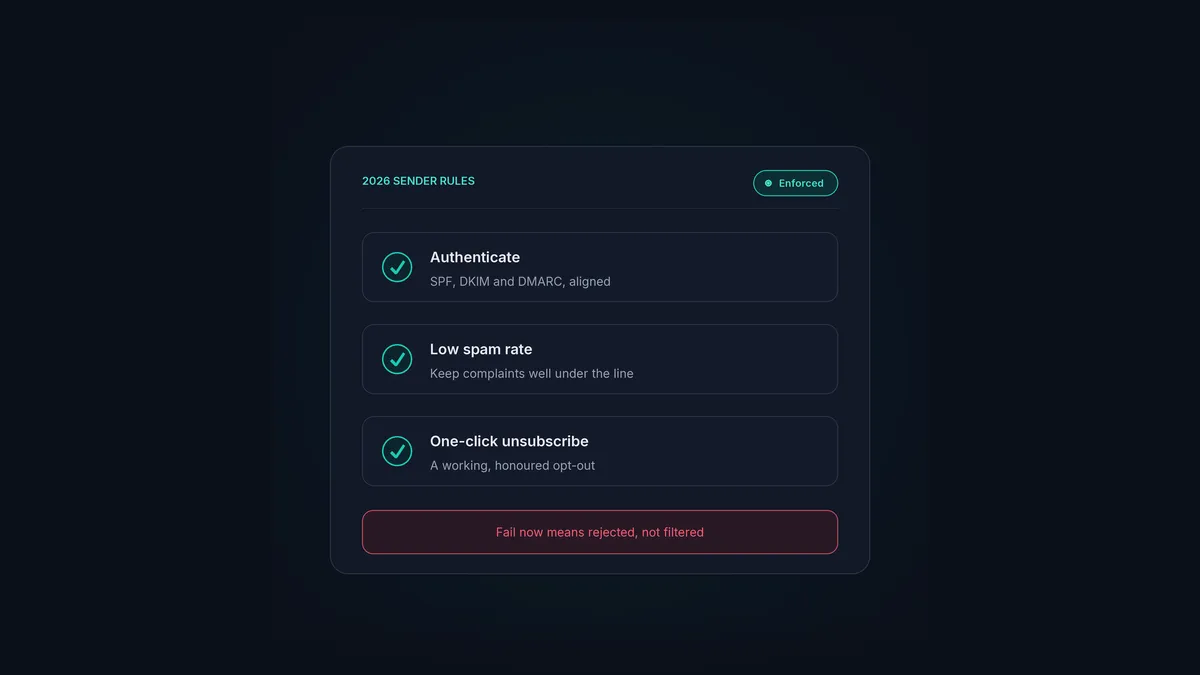
The rules for sending bulk email got stricter, and it matters more for cold email than almost anything else. Over the last couple of years Google, Yahoo and Microsoft moved their sender requirements from “recommended” to “enforced”, and in 2026 the penalty for ignoring them isn’t the spam folder any more. It’s outright rejection. Mail that fails the checks doesn’t arrive anywhere.
Here’s the plain-English version: what changed, what it means for cold email specifically, and exactly what to check on your own setup. Worth coming back to every so often, because this stuff keeps moving.
The short version
- Bulk sender rules from Google, Yahoo and Microsoft are enforced now, not advisory.
- Sending at volume needs SPF, DKIM and DMARC, all passing and aligned.
- Spam complaint rates have to stay low; cross the line and you get blocked.
- One-click unsubscribe is required for bulk senders.
- Failing senders now get hard rejections, not just spam filtering.
What actually changed
The headline: the major providers lined up on a shared set of sender requirements and started enforcing them with real teeth. The thresholds that now matter:
- Authentication is mandatory. Senders at volume need SPF, DKIM and DMARC, all passing and aligned with the From domain. Two out of three, or three that don’t align, no longer cuts it.
- Spam rates are policed. Google expects bulk senders to keep their spam complaint rate, as reported in Postmaster Tools, well in check, with a clear danger line above which your placement falls apart. Cross it and your mail gets blocked, not just filtered.
- One-click unsubscribe is required. Bulk senders have to offer a working one-click unsubscribe that providers can action, not a link buried at the bottom.
- DMARC has to progress. Publishing DMARC at
p=noneto monitor is a fine starting point, but providers expect you to move towardquarantineorrejectover time, not park onnoneforever.
The “bulk sender” line usually gets drawn around 5,000 messages a day per domain, but for cold email the safe assumption is that the strict rules apply to you regardless, because the whole direction of travel is universal enforcement.
The biggest change: rejection, not filtering
The bit that catches people out is the penalty. It used to be that failing these checks made you more likely to get filtered to spam. Now, mail that fails can be rejected at the door: the receiving server returns an error and the message never reaches any folder. Google and Microsoft both bounce non-compliant bulk mail with hard failure responses.
For cold email that’s a step change. A spam-foldered email at least got delivered. A rejected one is just gone, and a run of rejections flags a problem that drags down everything else you send. There’s no soft option for ignoring the requirements any more.
What to check on your own setup
Run through this against your sending:
- Authentication. Confirm SPF, DKIM and DMARC all pass and align with your From domain. Misalignment is the most common failure. The full setup is in SPF, DKIM and DMARC for cold email.
- DMARC policy. Make sure DMARC is published and you’ve got a plan to move from
nonetowardquarantineorreject. - Spam rate. Watch your complaint rate in Google Postmaster Tools and keep it well clear of the danger zone. It’s a domain reputation input as much as a compliance one.
- Unsubscribe. Make sure there’s a genuine, working unsubscribe path that providers can action.
- List hygiene and warmup. Keep bounces low with a clean, verified list, and warm every mailbox, because the new enforcement punishes exactly the cold-and-dirty sending that warmup and hygiene prevent.
Why this is good news if you do it right
It’s easy to read all this as bad news for cold email. For anyone sending well, it’s the opposite. Tighter enforcement clears out the worst spammers, the ones who can’t or won’t meet the bar, which means less noise fighting for the inbox and more trust going spare for legitimate senders. The requirements aren’t exotic; they’re the same fundamentals covered across this whole section. Do them properly and the tightening rules end up working in your favour.
A platform built for this keeps you on the right side of the line without you thinking about it. HotHawk runs native warmup and automatic inbox rotation, supports clean authentication, and surfaces the numbers these rules care about, like bounce and complaint rates, so compliance mostly takes care of itself when you’re sending properly.
Built for the stricter rules
HotHawk pairs native warmup, automatic inbox rotation and proper authentication support, so the sender requirements that trip others up are mostly handled for you.
See how warmup worksA few common questions
What are the 2026 bulk sender requirements? Google, Yahoo and Microsoft now require senders at volume to authenticate with SPF, DKIM and DMARC (passing and aligned), keep spam complaint rates low, and offer one-click unsubscribe. The rules are enforced, and failing mail can be rejected rather than filtered.
Do these rules apply to cold email? Yes, and cold email sits closest to the behaviour they police. The safe assumption is that the strict requirements apply to you regardless of volume, because enforcement is heading toward universal.
What happens if I don’t comply? Increasingly, hard rejection. Non-compliant bulk mail can be refused at the receiving server and never reach any folder, and a run of rejections damages your wider reputation. The fix is the fundamentals: authentication, low complaint rates, clean lists and warmup.
The 2026 changes raised the floor for sending email, and that floor is exactly where careless cold email used to sit. Meet the requirements, which are the same fundamentals good senders already follow, and the stricter world is one you can compete in. Start with the deliverability guide.
