Tim Ferriss Cold Email Template: What It Is, Why It Works, and How to Adapt It
HotHawk is cold email software for serious outbound teams.
Special offer
Get 50% more sending, FREE.
50% extra sending on any plan, every month.
On this page
The “Tim Ferriss cold email template” is the framework Ferriss has taught for years for getting busy, hard-to-reach people to actually reply. It came out of the world of emailing mentors, investors and famous experts cold, and the reason it’s still passed around more than a decade later is simple: the bones of it hold up, because it’s built on how busy people actually read email.
Here’s the original structure, why each part works, and how to adapt it for modern B2B cold outreach, which is a slightly different job but runs on the same principles.
The short version
- The framework is built for getting busy people to reply, which is exactly the cold email problem.
- It leads with a specific, genuine reason for reaching out, never with you.
- It keeps things short and makes the ask tiny and easy to say yes to.
- The core ideas adapt cleanly to B2B sales outreach.
- It's a structure to internalise, not a script to paste.
The core idea: respect the reader’s time
Everything in the framework comes from one insight. Busy people get a flood of email, they skim, and they decide in seconds whether to engage. So the email has to earn its place fast: prove it’s relevant, keep it short, and make replying nearly effortless. If any part asks too much, makes them work to understand it, demands a big commitment, or rambles, they move on.
That’s the whole philosophy. Be brief, be specific, and make it easy to say yes. It sounds obvious, and almost nobody does it, which is exactly why it works.
The original structure
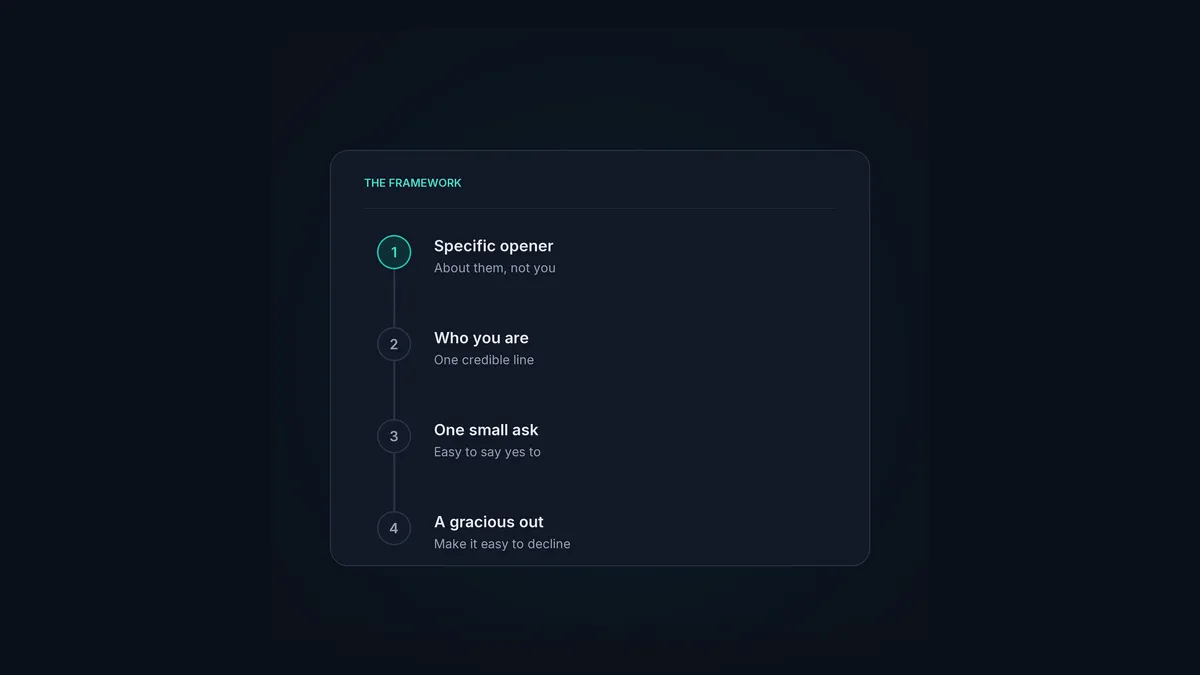
Strip the framework down and it’s four parts:
- A specific, genuine opener that isn’t about you. A real reference to their work, something they made, said or did. Not generic flattery (“I’m a huge fan”), something precise enough that it could only be written to them.
- A brief, credible line on who you are. One sentence. Enough to be taken seriously, not your life story.
- One small, specific ask. A single question they can answer quickly. The narrower and easier, the better. “Can I get 15 minutes?” beats “I’d love to pick your brain sometime.”
- A gracious out. Make it genuinely easy to decline. Counterintuitively, removing the pressure makes people more likely to say yes.
The magic is in how little it asks. Most cold emails fail by demanding too much, attention, time, a big leap. This one is engineered to be the easiest possible thing to respond to.
Why it still works
Inboxes have changed since Ferriss first wrote about this, but people haven’t. The reasons it works are timeless:
- It leads with relevance, not with you. The first line is about them, so they keep reading. The fastest way to lose a busy person is to open with “My name is X and my company does Y.”
- It’s short. Short emails get read. Long ones get saved for later, which means never.
- The ask is tiny. A small, specific request is easy to grant. A vague or large one is easy to ignore.
- It removes pressure. The gracious out signals you respect their time, which makes you the rare email they actually want to answer.
None of that has aged. If anything, in an inbox more crowded than ever, brevity and relevance matter more than they did.
Adapting it for B2B cold email
Ferriss’s version was about reaching individuals, often to learn from them. B2B cold outreach has a different goal, you’re starting a sales conversation, but the structure carries over almost unchanged:
- Specific opener: the trigger or detail that makes them relevant now. A hire, a funding round, a launch, a problem you can see they have.
- Credible one-liner: who you are and the one reason you’re worth a reply, framed as an outcome, not a feature list.
- One small ask: a single, low-friction next step. “Worth a quick look?” or “Open to 15 minutes next week?” rather than “Let me know your thoughts on the attached deck.”
- Easy out: “No worries if not the right time” does more work than you’d think.
The same rules from the cold email format guide apply: short, one clear ask, relevance up front. What Ferriss adds is the mindset, write for a busy person who owes you nothing, and the whole email gets sharper.
Where it fits in a real campaign
A framework gets you one great email. Cold email at scale needs that quality across hundreds of sends, plus follow-ups, plus deliverability, which is where the system around the email matters as much as the template. The Ferriss structure is a brilliant default for your first touch; the follow-ups are where most replies actually come from, and deliverability decides whether any of it arrives.
That’s the part a tool handles for you. HotHawk’s email sequencer runs the multi-step campaign with warmup and rotation underneath, so you can write Ferriss-quality first touches and trust they’ll reach the inbox and get followed up properly.
Great emails, sent properly
Write the email; HotHawk handles the rest. Multi-step campaigns with warmup and inbox rotation, and a master inbox that catches every reply you earn.
See the email sequencerA few common questions
What is the Tim Ferriss cold email template? A framework for getting busy people to reply: a specific, genuine opener about them, a brief credible line on who you are, one small easy ask, and a gracious out. It’s built around respecting the reader’s time.
Does the Tim Ferriss cold email template still work? Yes. The inbox has changed but people haven’t. Brevity, relevance and a tiny ask are arguably more effective now than when the framework was first taught, because inboxes are more crowded.
How do I adapt it for sales? Keep the four parts, but make the opener the trigger that makes the prospect relevant now, the credible line an outcome you deliver, and the ask a single low-friction next step. The structure barely changes.
The Tim Ferriss template lasts because it’s not really a template, it’s a way of thinking about the person on the other end. Internalise that, write for a busy reader who owes you nothing, and your cold emails get sharper whatever you’re selling. For the wider craft, start with the complete cold emailing guide.
