Cold Email Examples That Booked Real Meetings: Breakdown and Analysis
HotHawk is cold email software for serious outbound teams.
Special offer
Get 50% more sending, FREE.
50% extra sending on any plan, every month.
On this page
You can read about cold email structure all day, but it clicks faster when you see it working. So here are cold emails of the kind that book meetings, broken down line by line, so you can see exactly why each part pulls its weight and steal the thinking, not just the words.
Don’t copy these verbatim, the specifics are what make them work, and your specifics are different. Read them for the moves, then write your own. Each one follows the cold email format, so you’ll spot the same skeleton under different clothes.
The short version
- Strong cold emails all share a skeleton: specific opener, clear value, one easy ask.
- The opener does the heavy lifting; it proves the email was written for them.
- Value is framed as the prospect's outcome, never the sender's features.
- The best asks are small and specific, easy to answer in one line.
- Copy the structure and the thinking, never the exact words.
Example 1: B2B SaaS, trigger-based
Subject: noticed you’re hiring SDRs
Hi Dana,
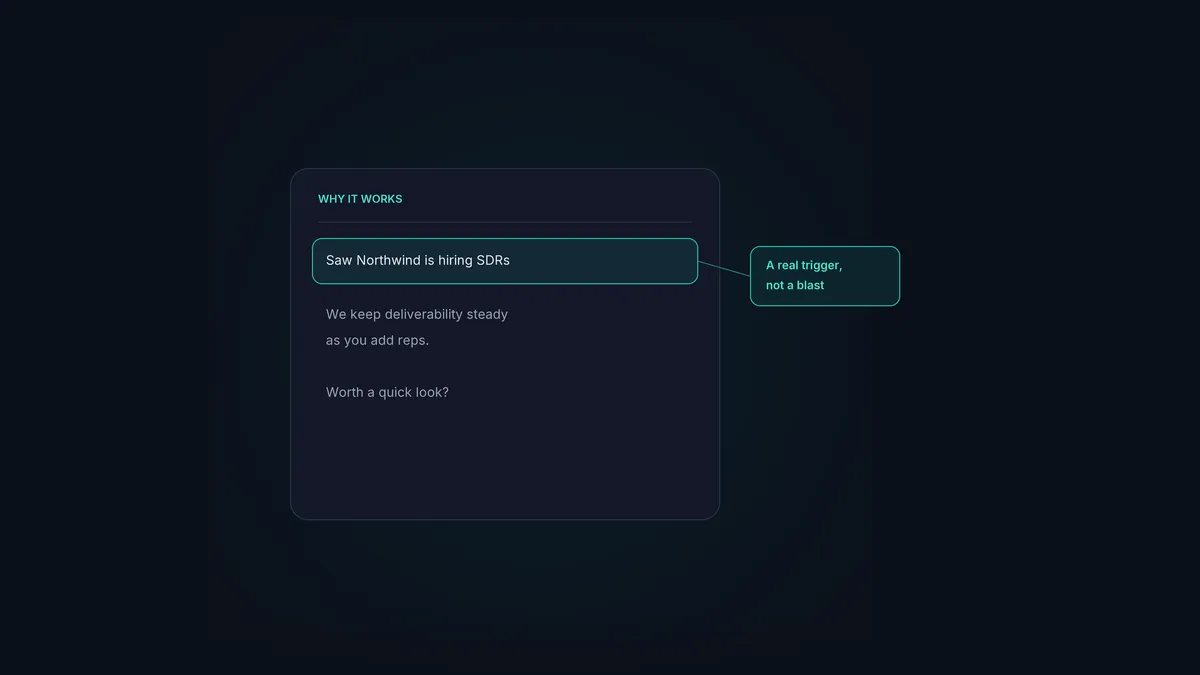
Saw Northwind is hiring three SDRs this quarter, that’s a lot of new mailboxes to get sending without torching your domain.
We help teams scaling outbound keep deliverability steady as they add reps, so the new hires actually reach inboxes from week one instead of month three.
Worth a quick look at how you’re set up for it?
Why it works. The subject and opener are built on a real trigger, the hiring, which proves this isn’t a blast. The second line names a specific pain that hiring creates (deliverability as you add mailboxes), so it’s relevant, not generic. The value is their outcome (“reach inboxes from week one”), not a feature list. The ask is tiny. Total: under 60 words.
Example 2: Agency, results-led
Subject: quick one on [Acme]’s outbound
Hi Sam,
We run cold email for B2B agencies, and last quarter we booked one of them 40 qualified meetings from a single domain.
I had a look at Acme’s setup and think there’s room to do something similar, especially around how replies are getting handled.
Open to me sending over the two things I’d change?
Why it works. It leads with a concrete result (40 meetings, one domain) rather than a vague promise. It shows homework (“I had a look at Acme’s setup”) and names a specific area, which makes the credibility stick. The ask reframes the next step as value to them (“the two things I’d change”), so saying yes feels like getting something, not giving something up.
Example 3: Enterprise, short and senior
Subject: 15 minutes, [first_name]?
Hi Lee,
I’ll keep this brief, I know your week’s full.
We help revenue teams your size cut the time a positive reply sits unanswered, which is usually where pipeline quietly leaks. For one team it meant 20% more meetings from the same campaigns.
Could I get 15 minutes next week to show you how?
Why it works. Senior people reward brevity, and this respects it from the first line. The value is sharp and quantified, and tied to a problem they’ll recognise (“where pipeline quietly leaks”). The ask is specific and bounded. No fluff, no feature dump, just a clear reason to give 15 minutes.
Example 4: Founder to founder
Subject: fellow founder, quick idea
Hi Priya,
Founder to founder, I’ll be straight, I think we could get [company] more replies from the outbound you’re already sending.
We did this for [similar company]: same volume, better setup, roughly double the reply rate.
If that’s interesting, I’ll send a two-line breakdown of what we’d change. If not, no hard feelings.
Why it works. The founder-to-founder framing builds instant rapport and earns directness. It promises more from effort they’re already spending (“the outbound you’re already sending”), which is an easy yes. The proof point is specific, and the easy out (“no hard feelings”) lowers the pressure, which paradoxically raises the response rate.
Example 5: The follow-up that got the reply
Subject: re: noticed you’re hiring SDRs
Hi Dana,
Floating this back up in case it got buried.
Since I wrote, you’ve posted two more roles, which makes the deliverability question even more worth a few minutes. Happy to keep it short.
Either way, good luck with the hiring.
Why it works. Most replies come from follow-ups, and this shows why. It’s short, it adds new, real information (the extra job posts), and it stays warm rather than passive-aggressive. The sign-off is gracious whatever happens. This is the follow-up principle in action: add value, don’t just nudge.
How to use these
Read them for the moves, then build your own swipe file from emails that actually got you replies, not ones that merely sound good. Over time your own winners teach you more than any example list, because they’re tuned to your market.
And remember that one great email is the start. Cold email at scale means hitting this quality across hundreds of sends, following up properly, and reaching the inbox in the first place. HotHawk’s email sequencer runs that machine underneath your copy, and the master inbox catches every reply your good emails earn, so the meeting-shaped ones never sit unseen.
Send your best emails at scale
HotHawk runs the campaign so your best cold emails reach the inbox and get followed up, with a master inbox that catches every reply they book.
See the email sequencerA few common questions
What does a good cold email look like? Short, with a specific opener that proves it was written for the reader, value framed as their outcome (often with a number), and one small, easy ask. The examples above all share that skeleton under different angles.
Should I copy cold email examples word for word? No. The specifics are what make them work, and yours are different. Copy the structure and the thinking, the specific opener, the outcome-led value, the tiny ask, then write in your own words about your own prospects.
How long should a cold email be? Short. The examples here are all under about 80 words. The goal is to start a conversation, not close a deal, so say just enough to earn a reply and keep the rest for when they’re interested.
The best way to get better at cold email is to study what works, take it apart, and write your own version. Steal the skeleton, not the sentences. For the structure behind every example here, see the cold email format guide, and for the whole craft, the complete cold emailing guide.
