Cold Email for an Internship: Step-by-Step Guide With 5 Proven Templates
HotHawk is cold email software for serious outbound teams.
Special offer
Get 50% more sending, FREE.
50% extra sending on any plan, every month.
On this page
Plenty of the best internships are never advertised. They get created when a sharp student emails the right person at the right company and makes it easy to say yes. Cold emailing for an internship works because so few students do it, which means a good email stands out instantly in an inbox full of formal applications.
Here’s how to do it step by step: who to email, what to say, five templates you can adapt, and how to follow up. It’s the same craft as any cold email, tuned for a student reaching out to start a career.
The short version
- Many internships aren't posted; emailing directly creates them.
- Email the person who runs the team, not a generic internships inbox.
- Lead with genuine enthusiasm for something specific, then make one small ask.
- Keep it short, show initiative, and don't expect them to do your work for you.
- A polite follow-up roughly a week later often gets the reply the first email didn't.
Who to email
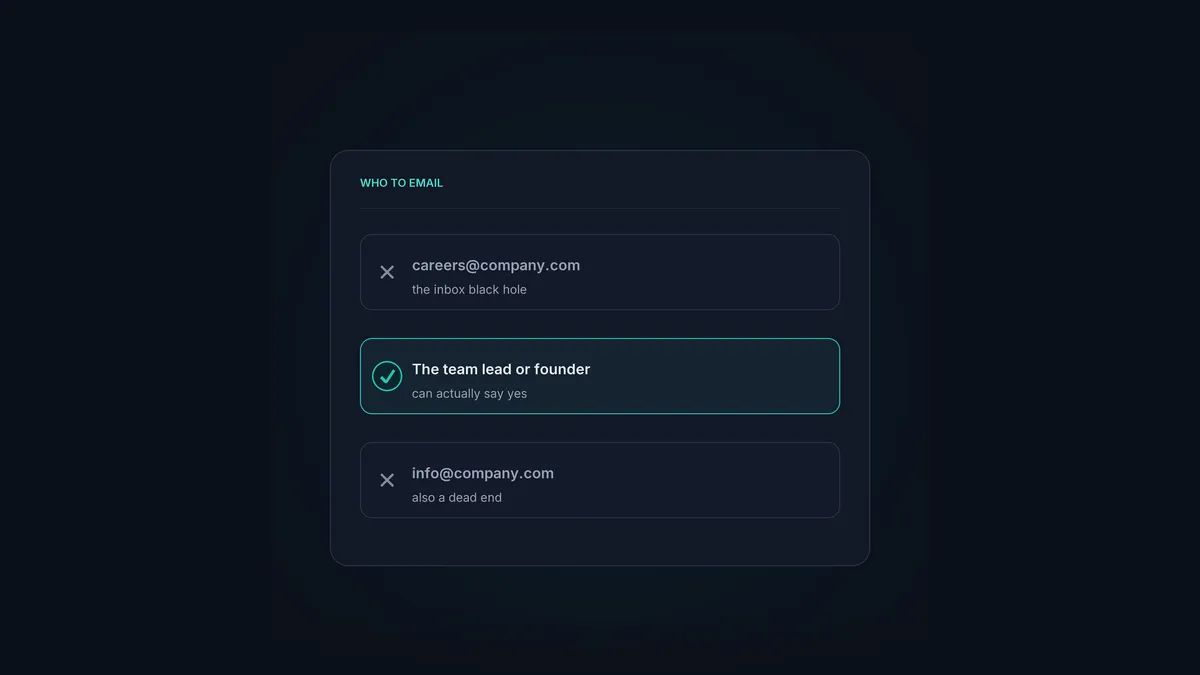
Find the person who’d actually work with an intern, a team lead, a manager, or at a small company, a founder. They can make a decision or create a slot. The generic careers or internships inbox rarely can. LinkedIn is the easiest way to spot the right person, then work out their email from the company’s usual format.
Targeting beats volume here, exactly like a good outbound list. Five well-researched emails to the right people beat fifty generic ones to info@.
The step-by-step
- Pick a handful of companies you genuinely care about. Enthusiasm is your biggest asset as a student, and it only reads as real if it’s specific.
- Find the right person at each. The team lead or manager, not the inbox.
- Write a short, specific email. A real reason you’re reaching out to them, a line on what you’d bring, and one small ask.
- Make it easy to say yes. Offer to work around them, link a CV or portfolio, and keep the ask tiny.
- Follow up once, politely, about a week later.
Five templates you can adapt
Replace the brackets with real detail. The specifics are the whole point.
1. The direct ask
Subject: internship at [company]?
Hi [first_name],
I’m a [year] [course] student at [university], and I’ve been following [company]’s [specific thing] for a while now.
I’d love to intern with your team. I’ve [specific relevant thing you’ve done: a project, a society, a skill], and I’m keen to learn from people doing it for real.
Would you be open to a quick chat about whether there’s a fit?
2. Inspired by their work
Subject: your work on [specific project]
Hi [first_name],
Your [specific project / talk / post] is a big part of why I want to get into [field]. It genuinely shaped how I think about it.
I’m studying [course] at [university] and looking for a summer internship. I’d jump at the chance to help your team, even on the unglamorous stuff.
Any chance you’d have 10 minutes to talk?
3. The skills-first pitch
Subject: [skill] student, keen to help
Hi [first_name],
I’m a [course] student who’s spent the last year getting good at [specific skill], and I built [specific project] along the way.
I’d love to put that to work as an intern at [company], which is doing exactly the kind of [field] work I want to be in.
Happy to send my portfolio. Would you be open to it?
4. Smaller company / startup
Subject: spare pair of hands?
Hi [first_name],
I know startups are always stretched, so I’ll keep this short. I’m a [course] student who can help with [specific thing], and [company] is exactly where I’d want to learn.
I’d happily intern part-time around my studies. If an extra pair of capable hands would be useful, I’m yours.
Worth a quick call?
5. The follow-up
Subject: re: [your original subject]
Hi [first_name],
Just bumping this in case it slipped past, I know you’re busy.
Since I emailed, I [new thing: finished a relevant project, learned a tool], which made me even keener to help at [company].
Totally understand if it’s not the right time.
Following up and what to avoid
Send one polite follow-up around a week after the first, and add a line of new value rather than just nudging. If there’s still nothing after a second try, leave it gracefully, the same follow-up etiquette that applies everywhere.
A few common questions
Does cold emailing for an internship work? Yes, and it’s one of the most underused tactics students have. Most internships filled this way were never advertised; a sharp, specific email to the right person creates the opportunity.
Who should I email about an internship? The person who’d manage the work, a team lead, manager, or founder at a small company, not a generic internships inbox. They can actually create or offer a slot.
What should I include in an internship cold email? A specific reason you’re emailing them, a short line on what you’d bring with real proof, and one small, easy ask. Keep it under 150 words and link a CV or portfolio rather than pasting it.
And if you later do this at scale for work, a cold email sequencer handles the sending and follow-ups for you. Cold emailing for an internship rewards initiative, and most students never try it. Pick companies you genuinely care about, reach the right person, lead with something specific, and make the ask small. For the wider craft, see the complete cold emailing guide.
