Cold Email Format: The Exact Anatomy of a High-Converting Outbound Email
HotHawk is cold email software for serious outbound teams.
Special offer
Get 50% more sending, FREE.
50% extra sending on any plan, every month.
On this page
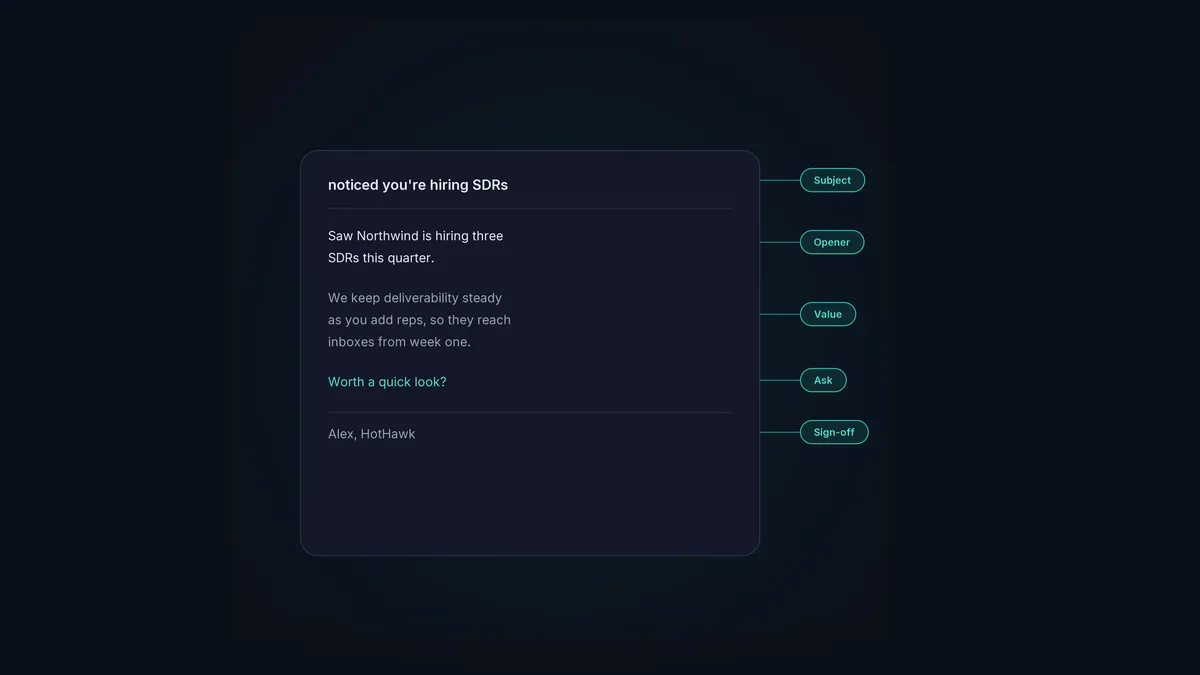
The format of a cold email isn’t a template you fill in, it’s a system where every part has one job. Get the structure right and the writing gets easy, because you stop staring at a blank page and start asking what each piece needs to do. Get it wrong and even good copy falls flat.
Here’s the exact anatomy: each element, what it’s there for, how long the whole thing should be, and the mistakes that quietly kill your reply rate.
The short version
- A cold email is a system of parts, each with a single job.
- Subject earns the open, opener earns the next line, value earns the reply, ask makes it easy.
- Keep the whole thing short, ideally under 120 words.
- Lead with the prospect, never with yourself.
- One clear ask beats a list of options every time.
The anatomy, part by part
A cold email has five parts. Think of them as a chain, each one’s job is to get the reader to the next.
1. Subject line, earns the open
Nothing else matters if this fails. The subject’s only job is to get the email opened, and the ones that work are short, specific and understated, the kind of thing a colleague might send. Save the clever stuff; it reads as marketing. We’ve got 50+ subject line examples if you want patterns to start from.
2. Opening line, earns the next sentence
This is the most important line in the email, and the one most people waste. It should be about them, not you. A reference to something specific, a hire, a launch, a post, a problem you can see, that proves this email was written for them and not blasted to a list. The fastest way to lose a reader is to open with “My name is X and I work at Y.” Nobody cares yet. Make them care first.
3. The value, earns the reply
Now you’ve earned a few more seconds, so give them a reason to respond. This isn’t your feature list. It’s the outcome you get them, ideally tied to the situation you referenced in the opener. Two or three lines, focused on what changes for them, not on how your product works. People reply to “what’s in it for me”, not “here’s everything we do”.
4. The ask, makes it easy
End with one clear, low-friction next step. One. The mistake is offering a menu (“happy to call, or send a deck, or connect on LinkedIn, whatever suits”), which makes the reader choose, and choosing is friction. Ask a single question they can answer in one line: “Worth a quick look?” or “Open to 15 minutes next week?” Make saying yes the easiest thing in the email.
5. The signature, builds trust quietly
Keep it simple and human: your name, role and company, maybe a link. Skip the giant banner, the legal disclaimer and the five social icons, they all add weight and shout “mass email”. A clean signature reads like a person; a cluttered one reads like a campaign.
How long should a cold email be?
Short. Aim for under 120 words, and treat anything that needs scrolling on a phone as too long. The instinct is to explain everything, which is exactly wrong, the goal of a cold email isn’t to close, it’s to start a conversation. Say just enough to earn a reply, then save the detail for when they’re interested.
A useful test: read it on your phone. If it looks like a wall of text, cut it until it doesn’t. Brevity isn’t just polite, it’s persuasive, because a short email signals you respect their time, which makes you worth replying to.
The format is the easy 80%, the input is the hard 20%
Here’s the honest bit. The format above gets you a clean, well-structured email, and that puts you ahead of most senders. But structure alone doesn’t get replies. The two things that do are the list (are you emailing the right person at the right moment) and the relevance (does the opener prove you understand them). A perfectly formatted email to the wrong person is still a dead email.
So treat the format as the foundation, not the whole house. Get it right so the writing’s easy, then put your real effort into who you target and the one line that proves you looked. The cold email examples guide shows the format working on real emails that booked meetings.
Where the format meets the machine
A great single email is one thing. Cold email at scale means that quality across hundreds of sends, the right follow-up timing, and the deliverability to actually reach the inbox. The format is your job; the rest is the system’s.
That’s what HotHawk runs underneath. The email sequencer handles the multi-step campaign, warmup and inbox rotation, so your well-formatted emails get delivered and followed up, and the master inbox catches every reply the format earns.
Format the email, automate the rest
Write the email; HotHawk runs the campaign underneath it. Multi-step sending with warmup and rotation, and a master inbox that catches every reply.
See the email sequencerA few common questions
What is the ideal cold email format? Five parts, each with one job: a short specific subject, an opener about the prospect, two or three lines of value framed as their outcome, one clear low-friction ask, and a clean human signature. Keep the whole thing under 120 words.
How long should a cold email be? Under 120 words is a good target, short enough to read on a phone without scrolling. The aim is to start a conversation, not to close, so say just enough to earn a reply and save the detail for later.
What’s the most important part of a cold email? The opening line. It has to be about the prospect and specific enough to prove the email was written for them. A weak, all-about-you opener loses the reader before the value or the ask ever gets a chance.
Get the format right and cold email stops feeling like guesswork. Each part has a job: subject opens, opener hooks, value convinces, ask converts. Nail the structure, then pour your effort into targeting and relevance. For the full craft, see the complete cold emailing guide.
