Cold Email Subject Lines That Get Opens: 50+ Examples for 2026
HotHawk is cold email software for serious outbound teams.
Special offer
Get 50% more sending, FREE.
50% extra sending on any plan, every month.
On this page
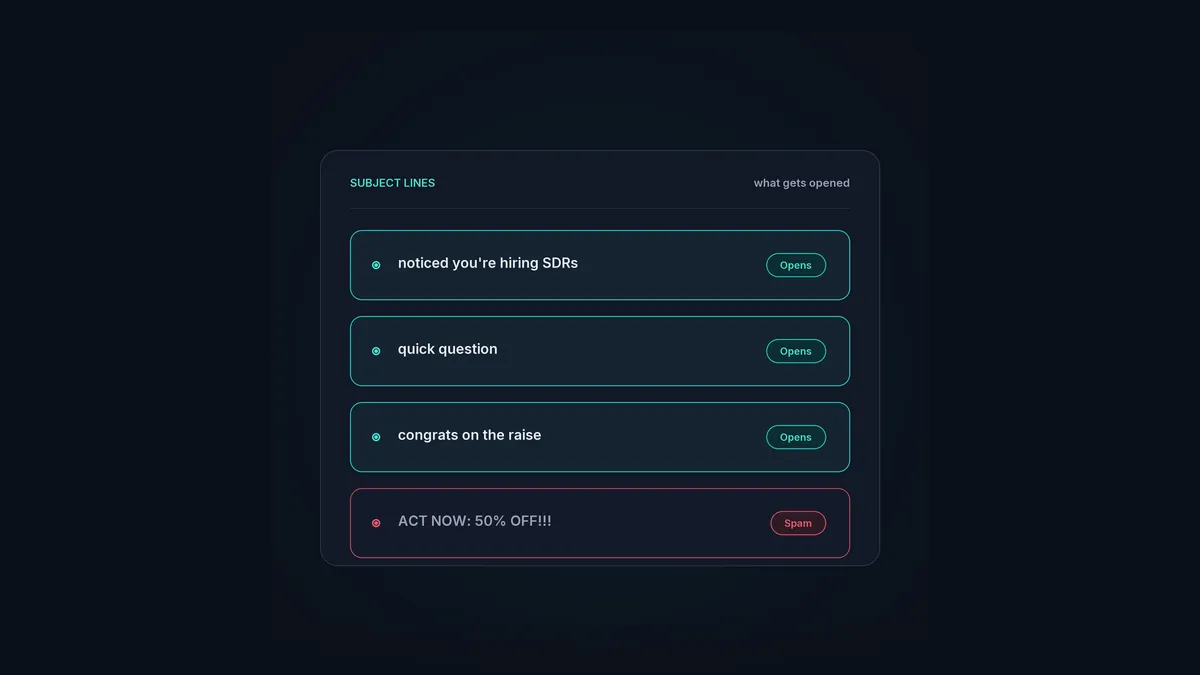
The subject line is a gate. If it doesn’t earn the open, the email you laboured over never gets read, so it’s worth more thought than most people give it. The good news is that cold email subject lines aren’t a dark art. The ones that work share a handful of patterns, and you can copy them.
Below are 50+ subject lines grouped by type, with the thinking behind each group, plus the kinds that quietly kill your open rate. Steal the patterns, not the exact words, because a subject line that fits your prospect always beats one lifted whole.
The short version
- The subject line's only job is to earn the open, nothing else.
- Short, specific, and understated beats clever, salesy or clickbait.
- Write the subject a real person would send, not one a marketer would.
- Personalised and curiosity-led lines tend to win in cold email.
- Avoid spammy words, false promises and anything that screams mass email.
What actually makes a subject line work
Before the list, the principle, because it’s what lets you write your own. A cold email subject line works when it reads like something a colleague might send: short, specific, no try-hard. It fails when it reads like a marketing blast: clever, hyped, stuffed with CAPS and emoji.
The reason is simple. People decide in a fraction of a second whether an email is worth opening, and “this looks like a sales email” is an instant skip. Anything that pattern-matches to mass email works against you. So the bar isn’t “is this catchy”, it’s “does this look like a real person emailing me on purpose”.
Curiosity subject lines
These open a small loop the reader wants closed. Used well they’re irresistible; overused or vague they read as clickbait, so keep them grounded in something real.
- quick question
- a thought on [company]
- worth a look?
- this made me think of you
- might be nothing
- one idea for [company]
- saw this, thought of you
- can I ask you something?
- probably not, but
- small thing about your outbound
Personalised subject lines
The strongest category in cold email, because they prove the email isn’t a blast. They reference something specific: the company, a role, a recent event. They take more work, and they’re worth it.
- congrats on the raise, [first_name]
- [company] + a quick idea
- noticed you’re hiring SDRs
- your post on [topic]
- about [company]’s new launch
- [first_name], quick one on [company]
- saw [company] just expanded
- following your work at [company]
- re: your [role] role
- idea after reading your [topic] post
Direct subject lines
Sometimes the honest, plain approach wins, especially with senior people who haven’t got time for games. These say what it is.
- 15 minutes next week?
- [company] x [your_company]
- cold email, but relevant
- pitch in two lines
- can I send you something?
- quick intro
- worth a conversation?
- [first_name], a straight ask
- about your cold email
- two minutes of your time
Pattern-interrupt subject lines
These break the rhythm of a normal inbox, which earns a glance. Use sparingly, because the novelty wears off fast and can tip into gimmicky.
- I’ll keep this short
- delete this if I’m wrong
- you’ll probably ignore this
- not a newsletter
- bad time?
- this is a cold email
- feel free to say no
- 30 seconds, promise
- last email, I promise
- swing and a miss?
Question subject lines
A plain question tied to the reader’s world invites a reply before they’ve even opened. Keep it specific to them, not generic.
- who handles outbound at [company]?
- still scaling the SDR team?
- is deliverability on your radar?
- worth fixing your reply times?
- open to a better setup?
How to test your way to better subject lines
The list gives you a starting point, but your audience is the only real judge. The way to actually improve is to test, run two or three subject lines against each other on the same campaign and watch which earns more opens. Over a few campaigns you’ll learn what your specific market responds to, which is worth more than any list.
A word of caution on open tracking, though: it’s noisy. Privacy features and pre-fetching inflate open rates, so don’t treat the number as gospel. Use it to compare subject lines against each other, not as an absolute. The metric that actually pays the bills is replies, so keep one eye on whether the opens are turning into conversations.
This is where running it in a real tool helps. HotHawk’s email sequencer lets you test subject line variants inside a campaign and see which pulls, while the master inbox tracks the thing that matters, the human replies underneath the opens.
Test subject lines that get replies
HotHawk lets you run subject line variants inside a campaign and track real human replies, not just noisy opens, so you optimise for conversations, not vanity.
See the email sequencerA few common questions
What makes a good cold email subject line? Short, specific, and understated, the kind of thing a colleague would send. It should look like a real person emailing on purpose, not a marketing blast. Personalised and genuine curiosity lines tend to win.
How long should a cold email subject line be? Short. A few words is often ideal, and it should read fine on a phone where it might get cut off. Long, descriptive subject lines read like newsletters, which is the opposite of what you want.
Should I use emojis in cold email subject lines? Generally no. Emoji pattern-match to marketing email, which works against you in cold outreach and can nudge you toward spam filters. Plain text reads more like a personal email, which is the goal.
The whole game with a cold email subject line is looking like a real person, not a campaign. Keep it short, make it specific, lead with relevance where you can, and test your way to what your market opens. For where the subject line fits the rest of the email, see the cold email format guide and the complete cold emailing guide.
