How to Write Cold Emails That Don't Get Ignored
HotHawk is cold email software for serious outbound teams.
Special offer
Get 50% more sending, FREE.
50% extra sending on any plan, every month.
On this page
Most cold emails get ignored for the same handful of reasons, and once you can see them, they’re easy to fix. Writing a cold email that gets a reply isn’t about being a brilliant copywriter. It’s about respecting the reader, leading with relevance, and making one easy ask. This guide walks through how to do that, with before-and-after rewrites so you can see exactly what changes the outcome.
If you want the underlying structure first, the cold email format guide lays out the skeleton. This one is about the writing itself.
The short version
- Write for the reader, not for yourself; lead with something about them.
- Cut every word that isn't earning its place; short emails get read.
- Talk about their outcome, not your features.
- Make one clear, low-friction ask, never a menu of options.
- Read it aloud; if it sounds like a brochure, rewrite it.
Start with the reader, not yourself
The most common mistake in cold email is making it about you. “My name is X, I work at Y, we do Z” is how almost every weak cold email opens, and it’s exactly where readers stop, because you haven’t given them a reason to care yet.
Flip it. Open with something about them, a specific detail that proves you’re emailing them on purpose. Earn their attention before you spend any of it on yourself. You can introduce who you are in one line later, once they’ve got a reason to read it.
Write the way you’d talk
Cold emails fail when they sound like marketing. Stiff, formal, full of “I hope this email finds you well” and “I wanted to reach out to touch base.” Nobody talks like that, and it reads instantly as a template.
Write the way you’d actually speak to this person if you bumped into them. Use short sentences. Use contractions. Cut the corporate throat-clearing. The goal is for it to feel like a real human took two minutes to email them, because the ones that feel like that are the ones that get replies.
Cut until it hurts, then cut a bit more
Length is the silent killer. Every extra sentence is another reason to put the email aside “for later”. So write your draft, then halve it. Cut the warm-up. Cut the second example. Cut the sentence explaining the sentence. If a word isn’t earning its place, it’s costing you.
A good cold email is usually under 120 words and reads fine on a phone. If yours needs scrolling, it’s too long, and the fix is almost always deletion, not rewriting.
Talk outcomes, not features
This is the one that quietly sinks technically-good emails. People don’t care what your product does; they care what changes for them. “We have AI reply categorisation and inbox rotation” is a feature list. “Your team stops missing positive replies across all those mailboxes” is an outcome. Same product, completely different email.
Before you send, read every claim and ask “so what, for them?” If the answer isn’t obvious, rewrite it as the result they get, not the thing you do.
Before and after
Here’s all of that applied to a real rewrite.
Before:
Subject: Introducing HotHawk
Hi there,
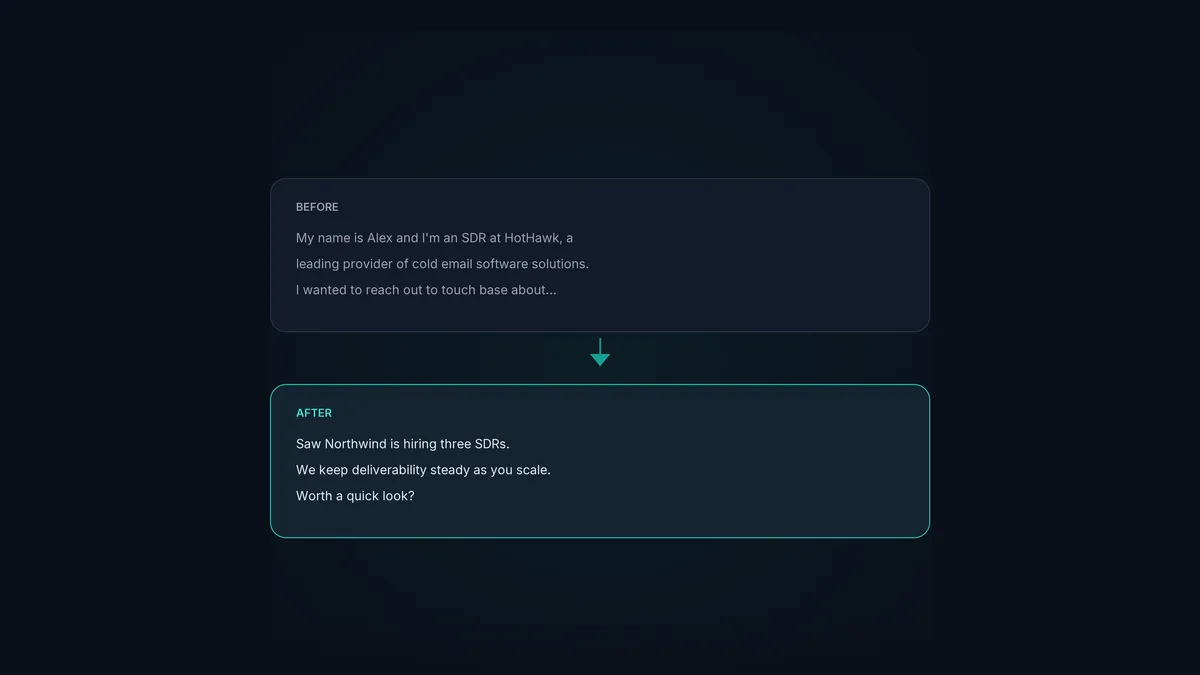
My name is Alex and I’m a Sales Development Representative at HotHawk, a leading provider of cold email software solutions. We offer a comprehensive platform with features including automated sequencing, inbox rotation, email warmup, and AI-powered reply management.
I wanted to reach out to touch base and see if you might be interested in learning more about how we could potentially help your business. Would you be available for a 30-minute call sometime next week to discuss your needs? I’m also happy to send over a deck, a demo, or connect on LinkedIn.
Looking forward to hearing from you!
After:
Subject: noticed you’re hiring SDRs
Hi Dana,
Saw Northwind is hiring three SDRs, that’s a lot of new mailboxes to get sending without burning your domain.
We help teams keep deliverability steady as they scale outbound, so new reps reach inboxes from week one instead of month three.
Worth a quick look at how you’re set up?
What changed. The subject went from all-about-us to a real trigger. The opener leads with them, not the sender. The feature list became one outcome. The five-option ask became one small question. And it dropped from 110 words of throat-clearing to under 50 words that earn a reply. Nothing clever happened, just every rule above, applied.
Writing well is half the job
Sharp writing gets you the reply. What you do next decides whether it becomes a meeting, and that’s where a lot of good cold email quietly leaks. A positive reply has a short shelf life, and at scale, across multiple inboxes, the meeting-shaped ones are exactly the ones that get buried.
So pair good writing with a system that catches what it earns. HotHawk’s email sequencer sends your emails at scale with warmup and rotation so they reach the inbox, and the master inbox surfaces every reply in one place, so the “yes, tell me more” you worked for never sits unseen.
Write it well, then catch the reply
HotHawk sends your cold emails at scale and pulls every reply into one master inbox, so the conversations your writing earns never slip through the cracks.
See reply managementA few common questions
How do you write a cold email that gets a reply? Lead with something specific about the reader, write the way you’d talk, keep it under 120 words, frame the value as their outcome, and make one easy ask. The before-and-after above shows all of it applied to a single rewrite.
Why do my cold emails get ignored? Usually because they’re about you instead of the reader, too long, written in stiff marketing language, focused on features instead of outcomes, or asking for too much. Fix those and your reply rate climbs without any clever copywriting.
How long should a cold email be? Under 120 words is a good rule, short enough to read on a phone without scrolling. The job of a cold email is to start a conversation, not close a deal, so say just enough to earn a reply.
Writing cold emails that get replies is mostly about subtraction: cut the throat-clearing, lead with the reader, talk outcomes, and make one easy ask. Read it aloud, and if it sounds like a person, send it. For the full craft, see the complete cold emailing guide.
