Cold Email vs Cold Call: Which Gets Better B2B Results in 2026?
HotHawk is cold email software for serious outbound teams.
Special offer
Get 50% more sending, FREE.
50% extra sending on any plan, every month.
On this page
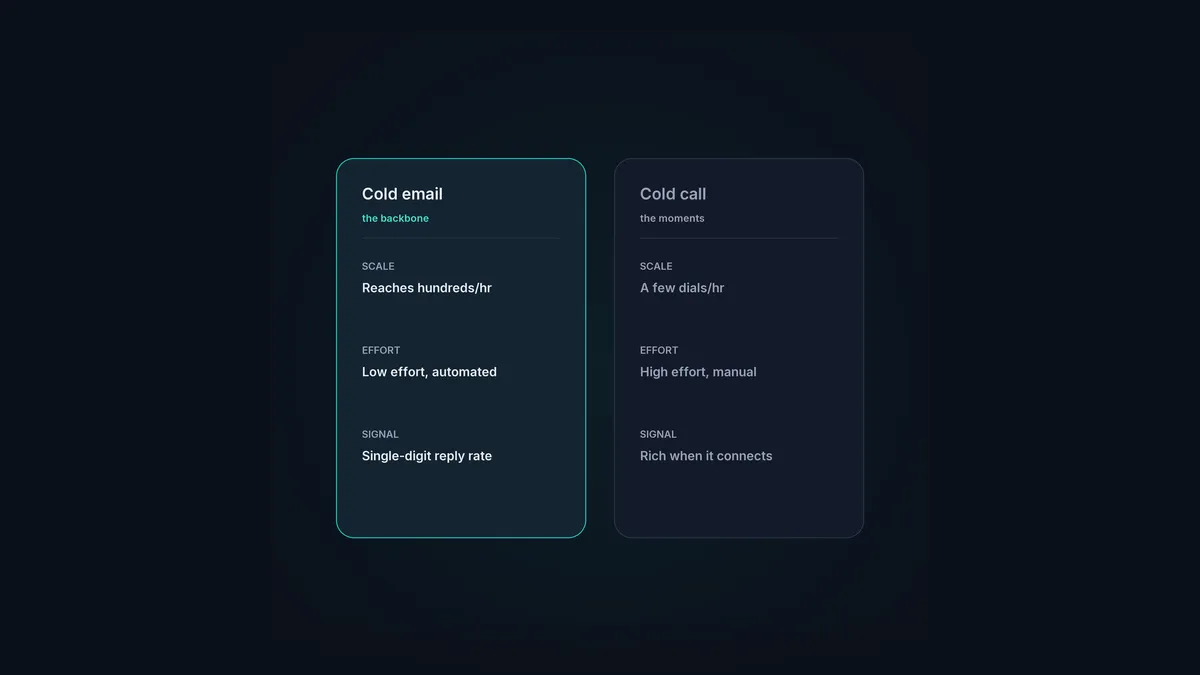
Cold email and cold calling are after the same thing, a conversation with a prospect who didn’t ask for one, and they go about it in opposite ways. One scales quietly in the background; the other is high-effort and high-contact. The “which is better” debate misses the point, because the honest answer for most B2B teams is that they do different jobs and the best teams run both.
Here’s how they actually compare, on the numbers and the trade-offs, and how to decide where to put your effort.
The short version
- Cold email scales and automates; cold calling is high-effort and high-signal.
- Email reaches far more people per hour; calls get a faster, richer response when they connect.
- Most strong outbound uses email as the backbone and calls for the high-value moments.
- Your market and motion decide the mix more than any universal rule.
- They work better together than either does alone.
The fundamental difference
Cold email is asynchronous and scalable. You can reach hundreds of people in the time it takes to research and dial a handful, it runs while you sleep, and software does the sending. The trade-off is that any single email is easy to ignore, so you’re playing a volume-and-relevance game.
Cold calling is synchronous and personal. When you get someone on the phone you get a real, immediate, two-way conversation, far richer than any email thread, and you can handle objections on the spot. The trade-off is effort and reach: dialling doesn’t scale, most calls don’t connect, and it’s draining work.
Neither is “better”. They’re different tools for different moments.
The numbers, honestly
It’s tempting to compare reply rates to connect rates as if they’re the same metric. They’re not, and that’s where most “X beats Y” claims fall apart.
- Cold email is a funnel of small percentages at large volume. A healthy campaign might see a single-digit reply rate, but you’re sending to hundreds or thousands, so the absolute number of conversations adds up, with very little human time per send.
- Cold calling is a funnel of larger percentages at tiny volume. When you actually reach someone, the odds of a real conversation are far higher than an email reply, but most dials don’t connect at all, and each one costs a rep real minutes.
So email wins on conversations-per-hour-of-effort, while a connected call wins on quality-and-speed of that single interaction. Comparing the raw percentages without that context tells you almost nothing. Track them the right way, by reply rate for email and connect-to-conversation for calls, and the picture gets honest.
Where each one wins
Cold email is the better default when:
- You’re reaching a lot of people and need to do it efficiently.
- Your market reads email more readily than they answer unknown numbers, which is most B2B.
- You want a repeatable, measurable, automatable motion.
- You’re testing messaging, email lets you learn fast across volume.
Cold calling earns its place when:
- The deal is big enough to justify the human time.
- You’re chasing a small, high-value list where every account matters.
- Email hasn’t broken through and a human touch might.
- Your buyers genuinely pick up, which varies a lot by industry and seniority.
Why email is usually the backbone
Even teams that love the phone tend to build on email, for one reason: it’s the only channel you can run at real volume without adding headcount. One rep can keep hundreds of prospects in a multi-step email campaign while making their calls to the warmest accounts. Email carries the breadth; calls carry the depth.
That only works if the email half is solid, though. Sending at volume means warmup, inbox rotation and deliverability, or your “backbone” quietly rots in spam folders. And it means catching every reply, because the whole point of email-at-scale is the conversations it surfaces for your reps to call into.
That’s the job HotHawk does. The email sequencer runs the multi-step backbone with warmup and rotation underneath, and the master inbox catches every reply across every mailbox, so your reps know exactly which warm accounts are worth picking up the phone for.
Run the email backbone properly
HotHawk runs your cold email at scale with warmup and inbox rotation, and surfaces every reply in one inbox, so your team knows exactly who's worth a call.
See the email sequencerA few common questions
Is cold email or cold calling more effective? Neither, on its own. Email reaches far more people per hour of effort and automates; a connected call gets a richer, faster conversation but doesn’t scale. Most strong B2B teams use email as the backbone and calls for high-value moments.
Does cold calling still work in 2026? Yes, for the right situations: big deals, small high-value lists, and markets where buyers actually answer. It’s high-effort and low-reach, so it pays off on quality of conversation, not volume, which is the opposite of email.
Should I use cold email and cold calling together? Usually, yes. They complement each other: email reaches and qualifies at scale, calls add a human touch at the moments that matter. A multi-channel cadence with email as the spine tends to beat either channel alone.
Cold email versus cold call is the wrong frame. They’re different tools, email for reach and efficiency, calls for depth and immediacy, and the best outbound uses both, with email as the backbone. For how to make the email half work, start with the complete cold emailing guide.
