Cold Email Agency Client Onboarding: The Step-by-Step Process to Launch Faster
HotHawk is cold email software for serious outbound teams.
Special offer
Get 50% more sending, FREE.
50% extra sending on any plan, every month.
On this page
Onboarding sets the tone for the whole client relationship, and it’s where a lot of agencies quietly lose people before a single email goes out. A slow, chaotic onboarding makes a client nervous they’ve hired the wrong agency. A sharp, structured one makes them feel in safe hands, and buys you the patience you need while campaigns warm up and ramp.
Here’s the step-by-step onboarding process that gets clients live faster and cuts the endless back-and-forth, so every new client starts the same smooth way.
The short version
- Onboarding sets the client's confidence before any results exist.
- A repeatable process beats bespoke chaos and gets campaigns live faster.
- Front-load the information you need so you're not chasing it later.
- Build in domains and warmup early, because they take time to get right.
- A clear approval step protects both sides and avoids rework.
Why a structured onboarding matters
The first few weeks with a client are fragile. There are no results yet, so all the client has to go on is how organised and confident you seem. A messy onboarding, missed information, unclear next steps, a slow start, plants doubt exactly when you can least afford it. A tight one does the opposite: it signals competence, and competence buys patience.
It also makes you faster and saves you money. A repeatable onboarding means you’re not reinventing the process for every client, you’re running a system, which gets campaigns live sooner and frees you to take on more clients without the wheels coming off.
The step-by-step process
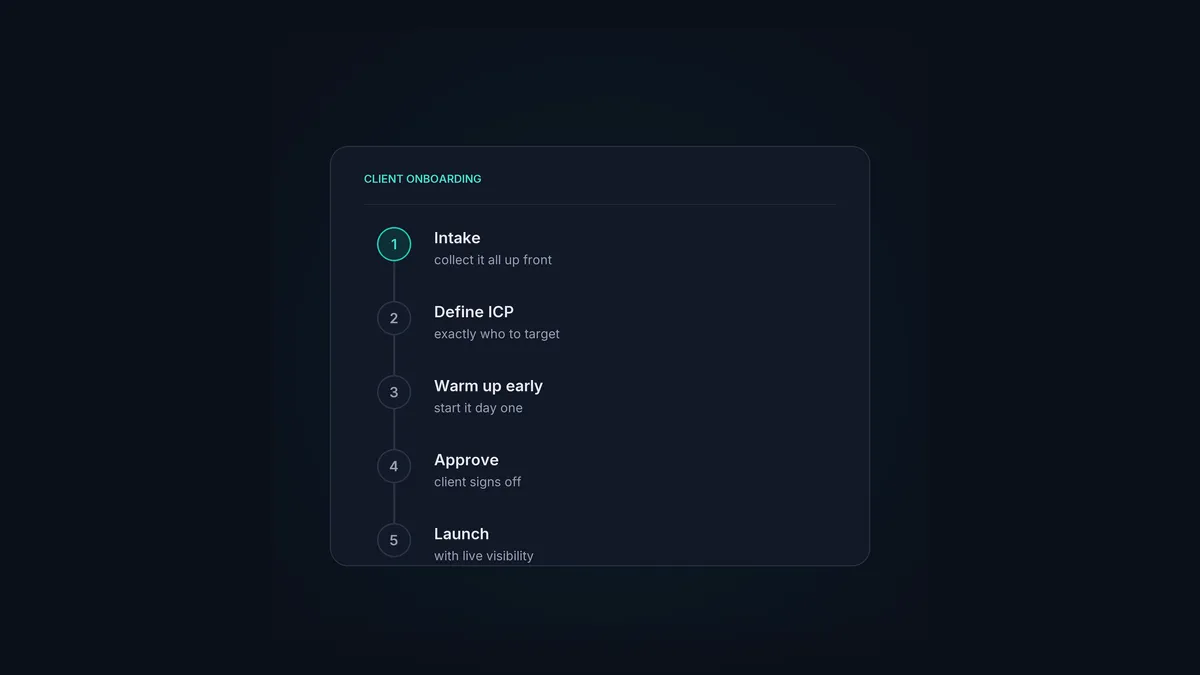
Step 1: intake
Collect everything you need up front, in one structured pass, rather than dribbling questions out over two weeks. That means the client’s offer, their target market, their past outbound results, their assets and case studies, their do-not-contact list, and access to anything you’ll need. A good intake form or kickoff call front-loads this, so you’re never blocked waiting on the client mid-build.
Step 2: define the ICP
Pin down exactly who you’re targeting before you write a word or build a list. Industry, company size, the roles you’re emailing, and the triggers that make a prospect relevant. This is the single most important decision in the whole engagement, so do it properly with the client’s input. A tight ideal customer profile makes everything downstream sharper.
Step 3: set up domains and warmup early
This is the step agencies skip and regret, because it’s the one with a built-in delay. New sending domains and mailboxes need warming before they can carry real volume, and that takes weeks. So start it on day one, in parallel with everything else, rather than waiting until the copy’s ready. Set up the client’s domains, authenticate them, and get warmup running immediately, so the infrastructure is ready when the campaigns are. Running this centrally across the client’s mailboxes, behind the scenes, is far less effort than doing it ad hoc.
Step 4: build the list and write the copy
With the ICP locked, build the verified target list and write the campaign, the first email plus follow-ups. This is your craft, and it’s where the client’s input on voice and positioning matters. Keep it tied to the ICP and the triggers you defined, so the relevance is built in rather than bolted on.
Step 5: approval
Before anything sends, get the client to sign off the list approach, the copy, and the targeting. A clear approval step protects both sides: the client feels in control, and you’re covered against “that’s not what I wanted” later. Make it easy, share the copy and the plan cleanly, get explicit sign-off, and you avoid the rework that eats margins.
Step 6: launch and report
Launch into the warmed mailboxes, and set expectations clearly: results ramp as the campaign warms and the messaging gets tested, so the first week is a start, not a verdict. Then give the client visibility from day one. This is where a client portal earns its place, the client logs in and sees activity and early replies as they happen, rather than waiting a month for a deck, which keeps them calm through the ramp.
A few common questions
What does cold email agency onboarding involve? A structured process: intake to collect everything you need, defining the ICP, setting up and warming domains early, building the list and writing the copy, getting client approval, and launching with clear expectations and visibility from day one.
How long should client onboarding take? It’s gated mainly by warmup, which takes weeks, so the trick is starting that on day one in parallel with everything else. With the slow infrastructure work front-loaded, the rest can move quickly, and you launch as soon as the mailboxes are ready.
How do I make onboarding repeatable? Turn each step into a standard process with templates: a structured intake form, an ICP framework, a domain-and-warmup checklist, copy templates, and a clear approval step. Running the same system every time gets clients live faster and lets you scale without quality slipping.
A good onboarding is a system, not an improvisation. Front-load the information and the warmup, define the ICP properly, build in a clear approval step, and give the client visibility from launch. Do it the same way every time and onboarding becomes a strength, not a scramble. For the wider picture, see the cold email agency guide.
