What Is a Sales Development Representative (SDR)? Role, Skills, and Salary in 2026
HotHawk is cold email software for serious outbound teams.
Special offer
Get 50% more sending, FREE.
50% extra sending on any plan, every month.
On this page
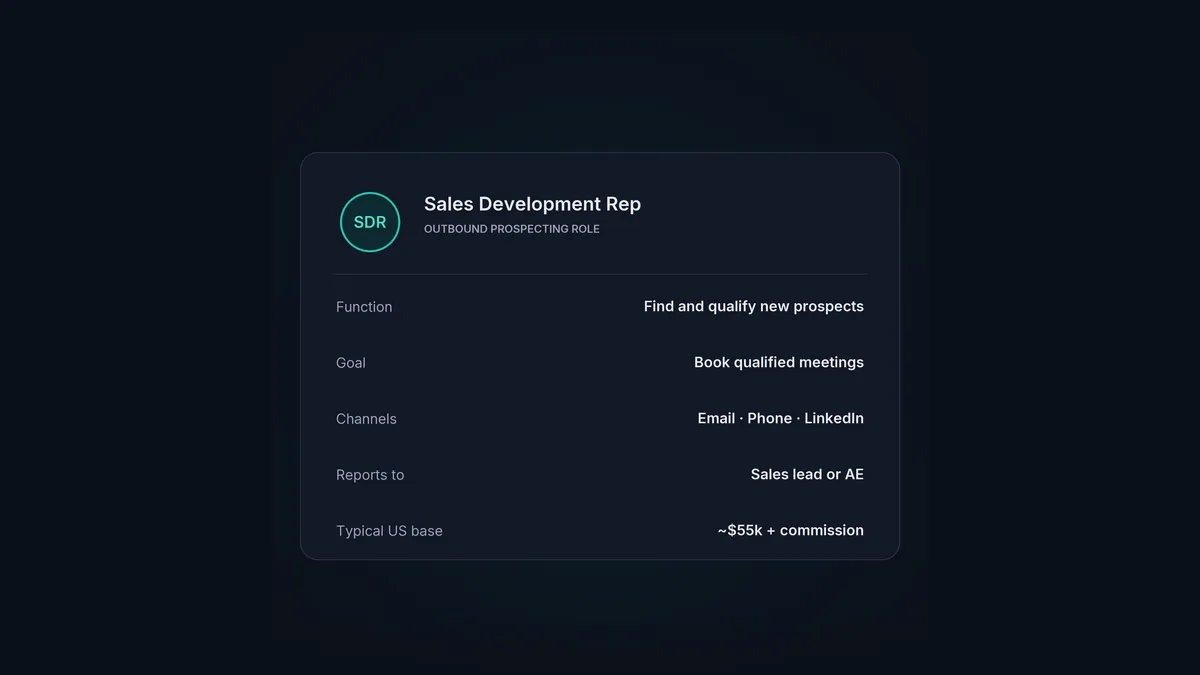
A sales development representative, or SDR, is the person who starts the sales conversations. Their job is to find new prospects, reach out to them, and book qualified meetings for the closers. They sit at the very front of the sales process, turning cold lists into real opportunities.
It is one of the most common entry points into a B2B sales career, and one of the most important roles on a sales team. Without SDRs filling the top of the funnel, the closers have nobody to talk to.
The short version
- An SDR finds prospects, reaches out, and books qualified meetings for Account Executives.
- They focus on the top of the funnel: prospecting and qualifying, not closing.
- Core channels are email, phone and LinkedIn, usually combined into a cadence.
- Key skills: resilience, research, clear writing, and consistency.
- It is a common first sales role and a stepping stone to becoming an AE.
What an SDR actually does
An SDR’s job splits into a few repeating activities:
- Research. Find the right accounts and the right people inside them, and learn enough to be relevant.
- Outreach. Run multi-touch campaigns across email, phone and LinkedIn to start conversations.
- Qualification. Work the replies, figure out who is a genuine fit, and weed out who is not.
- Booking meetings. Turn qualified interest into booked meetings on an Account Executive’s calendar.
Notice what is not on that list: closing deals. An SDR’s output is a qualified meeting, not a signed contract. That hand-off to a closer is the defining feature of the role.
SDR vs BDR vs AE
These three titles cause a lot of confusion, so here is the clean version:
- SDR (Sales Development Representative) focuses on prospecting and qualifying, often handling both inbound and outbound depending on the team.
- BDR (Business Development Representative) is frequently the same job under a different name, though some teams use BDR specifically for outbound. The SDR vs BDR guide covers when the distinction matters.
- AE (Account Executive) is the closer, who takes the meetings SDRs book and runs them to a deal.
In a small company, one person does all three. As a team grows, the roles split so each can specialise.
A day in the life
A typical SDR day is a rhythm of research, outreach and follow-up. Mornings often go to prospecting and personalised outreach while focus is high. Through the day they work their replies, handle outbound calls, book meetings, and keep the CRM updated. It is repetitive by design: consistency is the whole job.
The hard part is not any single task; it is doing them every day in the face of a lot of “no”. Which is why the most important SDR skill is not a clever email. It is resilience.
The skills that make a good SDR
- Resilience. Most outreach gets ignored. The good ones do not take it personally and keep going.
- Research and relevance. The ability to find the right people and say something true about them.
- Clear, concise writing. Cold email lives or dies on brevity and relevance.
- Consistency. Outbound rewards showing up every day, not heroic bursts.
- Coachability. The best SDRs treat every batch of replies as data and adjust.
Notice that none of these are about being a smooth talker. SDR is a process job, and process beats charisma.
Salary and career path
SDR is usually a base salary plus commission tied to meetings booked or pipeline created. Pay varies a lot by region, company stage and industry. The SDR salary guide breaks down base, OTE and how comp is structured.
As a career step, SDR is the classic on-ramp to an Account Executive role, and from there to sales management or revenue leadership. The skills you build, discipline, resilience, and an understanding of the whole funnel, carry all the way up.
The tools an SDR uses
The modern SDR stack has three parts: data to build lists, a sender to run outreach, and a CRM to track it. The sender is where a lot of an SDR’s day actually happens, so it matters that it does the unglamorous things well: protecting deliverability and catching every reply.
That is what HotHawk’s email sequencer and reply management inbox handle, and it is built with SDR teams in mind: fair lead routing, fast ramp for new reps, and full visibility for managers.
Give your SDRs an engine that works
HotHawk runs the outbound email backbone, routes every reply to the right rep, and gives managers full visibility, so SDRs spend their time on conversations, not admin.
Start your 7 day free trialA few common questions
What does an SDR do? Finds prospects, runs outreach across email, phone and LinkedIn, qualifies the replies, and books qualified meetings for Account Executives. They work the top of the funnel, not the close.
Is SDR a good first sales job? Yes. It teaches the fundamentals of prospecting, outreach and the sales funnel, and it is the standard path to becoming an Account Executive.
What is the difference between an SDR and an AE? An SDR books qualified meetings; an AE runs those meetings and closes the deals. SDR is the top of the funnel, AE is the bottom.
The SDR is the engine that fills the top of the sales funnel. It is a process role built on research, outreach, qualification and relentless consistency, and it is where most B2B sales careers begin. Get the SDR function right, with the right people and the right tools, and the whole sales team has something to work with.
