SDR Salary Guide 2026: What Sales Development Representatives Actually Earn
HotHawk is cold email software for serious outbound teams.
Special offer
Get 50% more sending, FREE.
50% extra sending on any plan, every month.
On this page
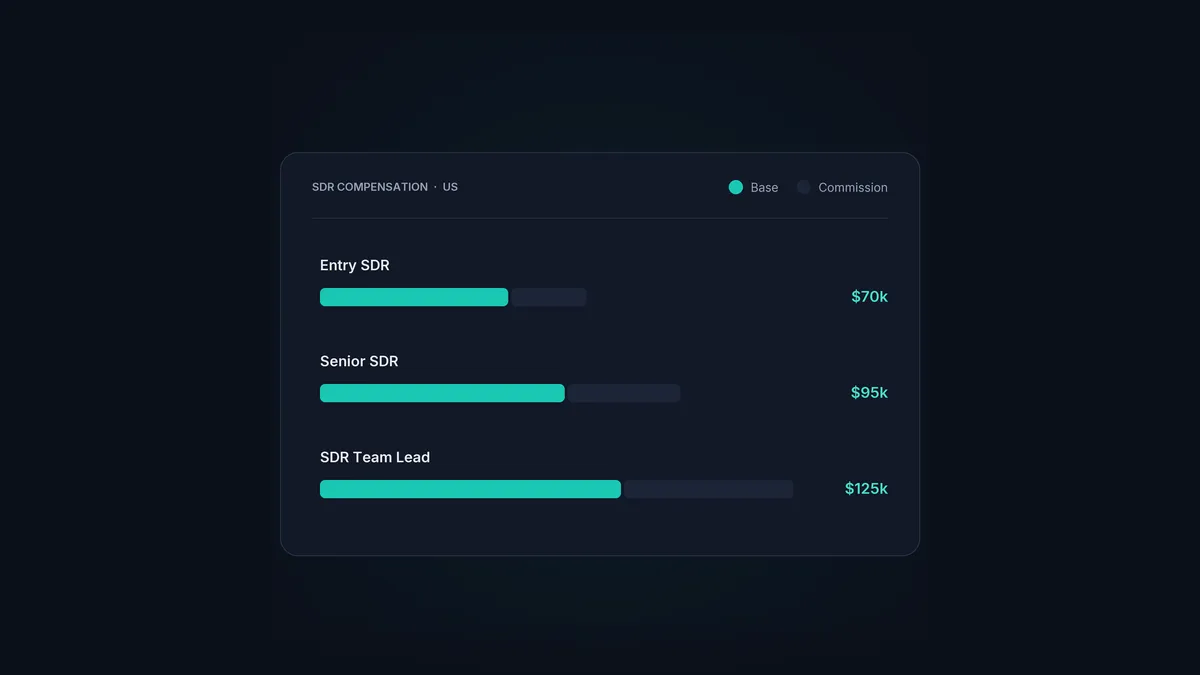
SDR pay has two parts, and most salary headlines only mention one. There is the base salary, which is fixed, and the variable, the commission tied to performance. Add them together at target and you get OTE, or on-target earnings, which is the number that actually matters when you are comparing roles.
This guide breaks down what sales development representatives earn in 2026: the structure, the ranges, and the things that move the number up or down. Treat the figures as directional. Pay swings a lot by region, industry and company stage.
The short version
- SDR pay is base salary plus variable commission. Together at target they make OTE.
- A common US split is roughly 70% base, 30% variable, though it varies widely.
- Entry SDRs often sit in the $50k to $70k OTE range; senior SDRs and leads earn more.
- Region, company stage and industry move the number more than anything else.
- Commission is usually tied to meetings booked or qualified pipeline created.
How SDR pay is structured
Almost every SDR role uses a base-plus-variable model:
- Base salary. Fixed pay you receive regardless of performance. It is the security part of the package.
- Variable (commission). Paid for hitting targets, usually meetings booked or qualified pipeline created. This is the part that rewards a strong month.
- OTE (on-target earnings). Base plus variable assuming you hit 100% of target. This is the headline number to compare across offers.
A typical split is around 70/30, so an SDR with an $80k OTE might have a $56k base and $24k of variable at target. Some companies lean more heavily on base for stability; others push more into variable to reward top performers.
Typical SDR salary ranges
These are broad US ranges for 2026. Your mileage will vary, sometimes a lot, but they give you a sense of the ladder:
- Entry-level SDR: roughly $50k to $70k OTE. A modest base with commission on top as you ramp.
- Senior or experienced SDR: roughly $70k to $100k OTE, reflecting a higher base and a track record of hitting target.
- SDR team lead or manager: often $100k or more OTE, mixing a higher base with team-based variable.
Outside the US, the same roles pay less in absolute terms but follow the same base-plus-variable shape. The structure travels; the numbers do not.
What moves SDR pay up or down
Three factors explain most of the variation:
- Region. Major tech hubs pay well above smaller markets for the same role, tracking local cost of living and competition for talent.
- Company stage and type. Well-funded SaaS companies tend to pay more than smaller or non-tech businesses. Faster-growing companies often pay up to fill the funnel quickly.
- Industry and deal size. SDRs selling large, complex deals usually earn more than those on high-volume, low-ticket products, because each meeting they book is worth more.
Experience and performance then layer on top. A proven SDR who consistently hits target has real bargaining power at renewal time.
How commission actually works
SDR commission is usually tied to a metric the SDR controls: meetings booked, or qualified meetings that convert to pipeline. Tying it to closed revenue is less common, because the SDR hands off before the close and cannot control whether the AE wins the deal.
The healthiest plans reward qualified output, not raw activity. Paying per meeting booked, with a qualification bar, keeps SDRs focused on booking the right meetings rather than gaming the number with junk.
Why productivity drives earnings
Here is the part that connects pay to the day job: an SDR’s earnings track how many qualified meetings they can book, and that depends heavily on their tools. An SDR fighting a clunky sender, chasing replies across scattered inboxes, and doing admin instead of outreach books fewer meetings and earns less.
Give the same SDR an outbound engine that handles the sending and surfaces every reply, and more of their day goes to the work that actually pays. That is the case for equipping SDR teams properly, and it is why the outbound sales playbook treats tooling as part of performance, not overhead.
More meetings, less admin
HotHawk runs the outbound email backbone and routes every reply to the right rep, so SDRs spend their time booking meetings, which is exactly what their commission rewards.
Start your 7 day free trialA few common questions
What is the average SDR salary? It depends heavily on region and company, but entry-level SDRs in the US commonly earn around $50k to $70k OTE, rising with seniority. Compare OTE, not base.
What is OTE for an SDR? On-target earnings: base salary plus the commission you would earn at 100% of target. It is the right number to compare across offers.
How is SDR commission calculated? Usually on meetings booked or qualified pipeline created, the outputs an SDR controls, rather than closed revenue, which the AE owns.
An SDR’s pay is base plus variable, and the OTE is the number that counts. Ranges climb with seniority and shift with region, company stage and deal size. When you compare roles, look past the base to the OTE, the split, and how many people actually hit it, because that is what you will really take home.
