What Is an Outbound Call? Types, Scripts, and Best Practices for SDRs
HotHawk is cold email software for serious outbound teams.
Special offer
Get 50% more sending, FREE.
50% extra sending on any plan, every month.
On this page
An outbound call is a call a rep makes out to a prospect or customer, rather than one that comes in. The rep initiates it, usually to start a sales conversation, follow up on earlier outreach, or move a deal forward. It is the phone half of outbound, and despite endless predictions of its death, it still works.
The phone reaches people email cannot, and a real voice builds rapport a written message cannot. It does not scale the way email does, which is exactly why it is best used for the moments that deserve a human. Here is what outbound calling is, the types, and how to do it well.
The short version
- An outbound call is a proactive call from a rep to a prospect, not an incoming one.
- Types include cold calls, follow-up calls, and warm calls after earlier contact.
- A good call has a clear structure: opener, permission, reason, and a single ask.
- Calling is high-effort and high-signal, so reserve it for moments that deserve a human.
- It works best alongside cold email, not instead of it.
What an outbound call is
The defining feature is direction: the rep makes the call, to someone who did not ring them. That separates it from an inbound call, where a prospect or customer reaches out first.
Outbound calls are part of the outbound sales motion. An SDR might use them to break into an account, to follow up on a cold email, or to nail down a meeting that has been drifting. The goal is almost always the same: start or advance a conversation that leads to a booked meeting.
Types of outbound call
- Cold calls. To a prospect with no prior relationship. The hardest version, since you are interrupting a stranger, but still effective when targeted and relevant.
- Follow-up calls. After earlier outreach, an email, a previous call, a demo, to keep momentum. Warmer, because there is context to reference.
- Warm calls. To someone who has shown some interest, such as an inbound lead or an event contact. The easiest, since there is a reason to expect the call.
The colder the call, the more the first ten seconds matter, because you are earning the right to continue from a standing start.
The anatomy of a good outbound call
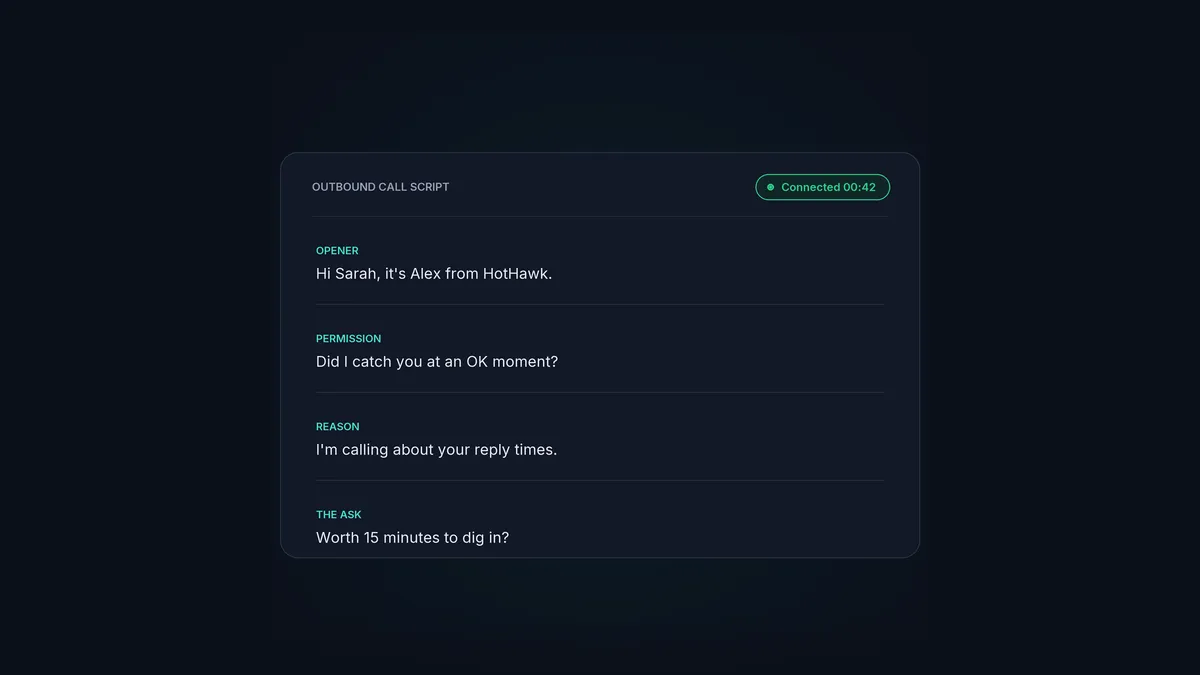
The best calls are not scripted word for word, but they do follow a structure. A reliable one:
- Opener. Say who you are, plainly. “Hi Sarah, it’s Alex from HotHawk.”
- Permission. Acknowledge you have interrupted them. “Did I catch you at an OK moment?” It disarms the reflex to hang up.
- Reason. One clear, relevant reason you are calling, ideally tied to their situation. “I’m calling about your reply times.”
- The ask. A single, small next step. “Worth 15 minutes to dig in?”
Notice what is missing: a monologue. The aim is a short, respectful opening that earns a conversation, not a pitch you read at them.
Outbound calling best practices
- Research first. Even one relevant detail about the person or company transforms a cold call from spam to a reason to listen.
- Lead with relevance, not a pitch. Open on their world, not your product.
- Keep the ask small. You are selling the next step (a meeting), not the deal.
- Expect the no. Most calls will not connect or will end quickly. Volume and resilience are the job.
- Log it and follow up. A call without a follow-up email is half a touch. Send a recap while it is fresh.
How calling pairs with cold email
Outbound calls are most effective as part of a multi-channel sales cadence, not on their own. Email is the scalable backbone that runs in the background at volume; calls are the high-touch moments slotted in where they count, breaking into a key account or chasing a warm reply.
The two reinforce each other. A prospect who has seen your name in a couple of emails is far more receptive when you call, and a voicemail backed by an email gives them two ways to respond. That is why the email sequencer handles the email steps automatically, freeing the rep to spend their time on the calls where a human voice actually moves the needle.
Automate the email, focus on the call
HotHawk runs the email backbone of your cadence automatically and catches every reply in one inbox, so your reps can put their energy into the calls that count.
Start your 7 day free trialA few common questions
What is an outbound call? A call a rep makes out to a prospect or customer to start or advance a sales conversation, as opposed to an inbound call where the other person reaches out first.
Does cold calling still work in 2026? Yes, when it is targeted and relevant. It reaches people email cannot and builds rapport a written message cannot. It works best alongside email rather than on its own.
What should an outbound call script include? A plain opener, a permission check, one clear reason for the call, and a single small ask. Keep it short and lead with the prospect’s world, not your pitch.
An outbound call is the proactive, human end of outbound sales: the rep picks up the phone and starts the conversation. Used well, with research, a respectful structure, and a single clear ask, and paired with an email backbone that does the scaling, it remains one of the most direct ways to turn a cold prospect into a booked meeting.
