Cold Email Agency Pricing: How to Structure Retainers and Performance Deals
HotHawk is cold email software for serious outbound teams.
Special offer
Get 50% more sending, FREE.
50% extra sending on any plan, every month.
On this page
How you price your cold email agency shapes everything: the clients you attract, the margin you keep, and how much risk you carry. Get it right and you build a calm, profitable business. Get it wrong, usually by pricing too low to win deals, and you end up overworked, underpaid, and unable to invest in the systems that would let you grow.
Here are the three pricing models, what clients expect to pay, and how to avoid the race to the bottom that drags so much of this industry down.
The short version
- The three models are flat retainer, pay-per-meeting, and hybrid.
- Retainers are predictable; performance pricing is attractive but riskier on margin.
- Price for margin from the start; underpriced clients are the hardest to keep.
- Define 'qualified meeting' precisely before agreeing any performance deal.
- Compete on results and reliability, not on being the cheapest.
The three pricing models
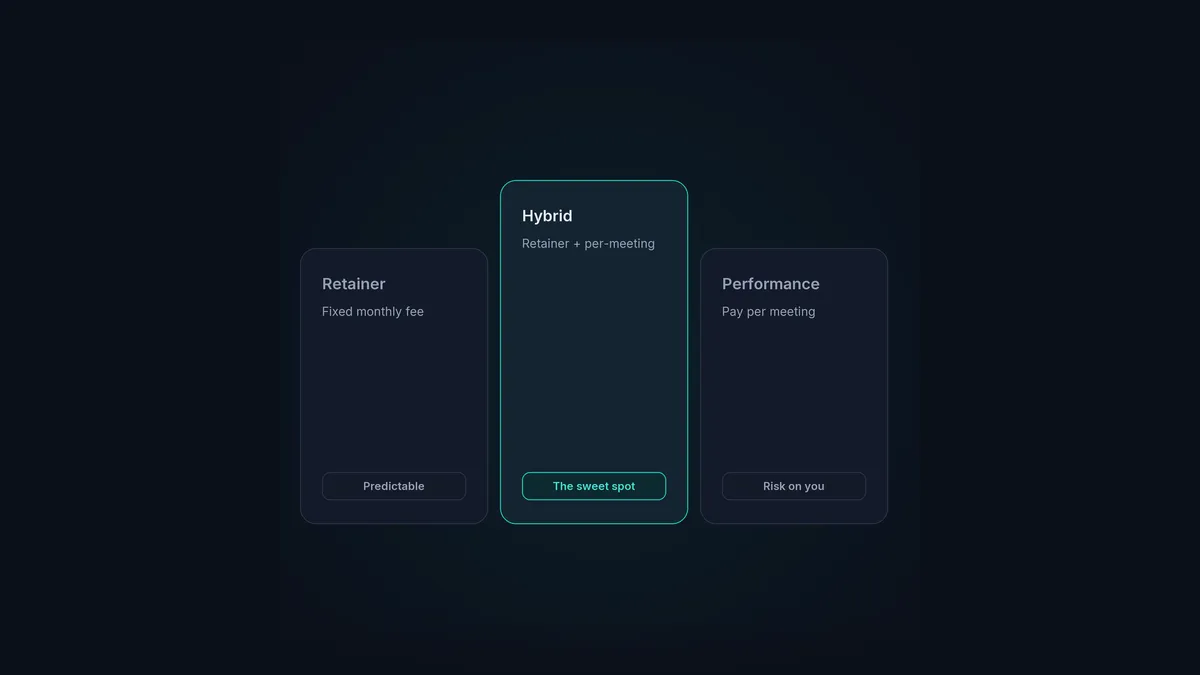
Flat retainer. A fixed monthly fee for a defined service. It’s the most common model and the easiest to run a business on, because the income is predictable and you can forecast against it. The risk sits with you, you’re paid the same whether results are great or slow, so it rewards agencies confident in their delivery. Clients like the predictable cost, though they may push for performance terms if they’re nervous about results.
Pay-per-meeting (performance). You’re paid per qualified meeting booked. Clients love it because it feels low-risk, they only pay for outcomes, and it’s an easy sell. The catch is the risk transfers to you, and it can be brutal on margin if deliverability dips or a client’s market is tough. It also lives or dies on the definition of “qualified”, which is where these deals go wrong.
Hybrid. A smaller retainer plus a per-meeting fee. This is often the sweet spot: the retainer covers your costs and keeps the lights on, while the performance kicker gives both sides upside and signals your confidence. It shares the risk rather than dumping it on either party, which tends to make for healthier, longer client relationships.
What clients expect to pay
There’s no single market rate, it varies with your niche, the volume, and your track record, but a few principles hold. Specialist agencies with proven results in a niche command more than generalists. Performance deals carry a higher per-unit cost to compensate you for the risk. And the very cheapest end of the market is a trap for everyone: clients get corners cut, agencies can’t afford to deliver, and nobody’s happy.
The honest framing for a client is that good cold outreach has real costs, infrastructure, data, skilled people, deliverability, and pricing has to cover those plus margin, or the service quietly degrades. Clients who understand that make better clients.
How to avoid the race to the bottom
Cold email has a low barrier to entry, which means there’s always someone willing to undercut you. Competing on price against them is a losing game, because there’s no floor, and the cheapest agencies tend to deliver the worst results, which poisons the well for everyone. The way out isn’t to match them, it’s to not compete on price at all.
You do that by competing on the things cheap agencies can’t credibly offer:
- Results and proof. Case studies and specific numbers beat a lower price for any serious client.
- Reliability and deliverability. The thing cheap agencies cut is exactly the thing that decides results, so make your competence here visible.
- Visibility and experience. A client who can log into a branded portal and see their wins as they happen feels looked after in a way a cheap operator can’t match.
That last one is underrated. Clients churn from anxiety as much as from results, and continuous visibility removes the anxiety. A white-label client portal where clients see their reporting, positive replies and live opportunities is a genuine reason to charge more and keep clients longer, which is worth far more than winning a deal on price.
Charge more, churn less
HotHawk gives your clients a branded ClientBox portal with live reporting, positive replies and opportunity tracking, the visibility that lets you compete on value, not price.
See ClientBoxA few common questions
How do cold email agencies charge? Three main ways: a flat monthly retainer, a pay-per-meeting performance fee, or a hybrid of a smaller retainer plus a per-meeting fee. Retainers are predictable; performance deals shift the risk to the agency; hybrids share it.
What should I charge for cold email agency services? Enough to cover your real costs, infrastructure, data, people, deliverability, plus margin. Exact rates vary with niche, volume and track record, but pricing too low to win deals is the most common and most damaging mistake.
How do I avoid competing on price? Compete on results, reliability and visibility instead. Show proof, be visibly competent on deliverability, and give clients continuous visibility through a branded portal. These are things cheap agencies can’t credibly match, and they justify a higher price.
Pricing is a strategic decision, not an afterthought. Pick a model that fits your appetite for risk, define performance terms precisely, and refuse to compete on being cheapest. For the wider operational picture, see the cold email agency guide.
