Sales Engagement Platform: What It Is and Whether You Actually Need One
HotHawk is cold email software for serious outbound teams.
Special offer
Get 50% more sending, FREE.
50% extra sending on any plan, every month.
On this page
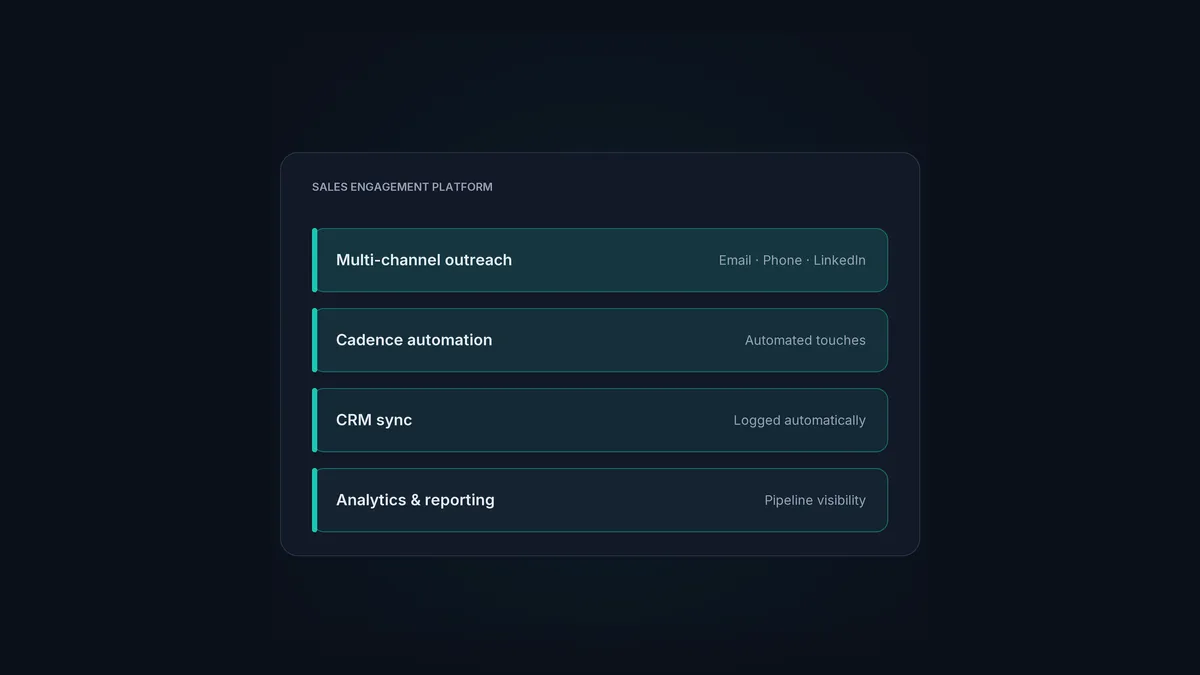
A sales engagement platform, or SEP, is software that runs and tracks a sales team’s outreach across multiple channels from one place. It bundles multi-channel outreach (email, phone, LinkedIn), cadence automation, CRM sync, and analytics into a single tool, so reps work from one screen and managers see everything.
They are powerful, and for some teams they are essential. For others they are an expensive way to do what a focused tool does better. The honest question is not “are SEPs good?” but “do you need one, or just a sharp tool for the job you actually have?”
The short version
- A SEP unifies multi-channel outreach, automation, CRM sync and analytics in one platform.
- It suits larger sales orgs running complex, multi-channel motions across many reps.
- The trade-offs are cost, complexity, and features you may never use.
- For focused cold email outbound, a dedicated sender often wins on simplicity and price.
- Match the tool to the job: a platform for a big multi-channel team, a focused tool for cold email.
What a sales engagement platform does
A SEP pulls the moving parts of outbound into one system:
- Multi-channel outreach. Email, phone dialling, and LinkedIn touches, managed together rather than in separate tools.
- Cadence automation. Structured, multi-step, multi-channel cadences that tell reps what to do next and automate the parts that can be automated.
- CRM sync. Every activity logged automatically against the contact and deal.
- Analytics. Reporting on activity, conversion and rep performance across the team.
The pitch is consolidation: one place for reps to work, one source of truth for managers, fewer tools to stitch together. For a large sales organisation, that consolidation is genuinely valuable.
Who actually needs one
SEPs earn their keep when a few things are true:
- You have a sizeable sales team running the same motion across many reps, where consistency and shared reporting matter.
- Your motion is genuinely multi-channel, with phone and LinkedIn doing real work alongside email rather than bolted on.
- You are tied to a CRM and need tight, automatic logging across the whole team.
If that is you, a SEP can be the right backbone. The bigger and more multi-channel the team, the stronger the case.
The trade-offs
SEPs are not free wins. The costs are real:
- Price. Enterprise platforms are expensive, often sold by quote with seat minimums. The per-rep cost adds up fast.
- Complexity. They are heavy tools with a learning curve. Reps can spend more time managing the platform than selling.
- Feature bloat. You pay for a broad feature set, much of which a focused team never touches.
- Deliverability is rarely the strength. Most SEPs are built around workflow and CRM integration, not the deliverability fundamentals, native warmup, inbox rotation, that cold email at scale depends on.
That last point matters most for cold outbound. A platform optimised for managing warm, CRM-connected activity is not necessarily good at sending cold email well.
SEP versus a focused cold email tool
Here is the decision most teams are actually weighing. If your outbound is primarily cold email, with calls and LinkedIn as supporting touches, a full SEP is usually more than you need. A focused email sequencer gives you the thing that actually decides results, deliverability and reply handling, without the enterprise weight and price.
We compare the two approaches directly on the head-to-head pages, including HotHawk vs Salesloft and HotHawk vs Outreach. The short version: pick a SEP when you are a large, multi-channel sales org; pick a focused sender when cold email is the core of your motion and you want it done well at a sane price.
Focused on the part that drives results
HotHawk is a cold email sequencer built on deliverability and the best reply management in the market, at one honest price. No enterprise bloat. Try it free for 7 days.
Start your 7 day free trialBuild, buy, or focus
Three honest paths:
- Buy a SEP if you are a big sales org running a complex, multi-channel motion and value consolidation over depth.
- Use a focused tool if cold email is the heart of your outbound and you want deliverability and reply management done properly without paying for the rest.
- Stitch your own stack if you have specific needs and the appetite to integrate, pairing a focused sender with a separate dialler and your CRM.
There is no universal answer. The outbound sales playbook covers how to build the motion first, then choose the tools that fit it, rather than letting a tool dictate the motion.
A few common questions
What is a sales engagement platform? Software that runs and tracks a sales team’s multi-channel outreach from one place, bundling email, phone, LinkedIn, cadence automation, CRM sync and analytics.
Do I need a sales engagement platform? Only if you are a sizeable, genuinely multi-channel sales team that values consolidation. For focused cold email outbound, a dedicated sender is usually leaner, cheaper and better at deliverability.
What is the difference between a SEP and a cold email tool? A SEP is a broad, multi-channel workflow platform. A cold email tool is focused on sending cold email well, prioritising deliverability and reply handling over breadth of features.
A sales engagement platform is the right backbone for a large, multi-channel sales organisation, and overkill for a team whose outbound is really about cold email. Decide what your motion actually is, then buy the tool that does that job best, rather than the one that does the most jobs adequately.
