HubSpot Sequences vs Dedicated Email Sequencer: When HubSpot Isn't Enough
HotHawk is cold email software for serious outbound teams.
Special offer
Get 50% more sending, FREE.
50% extra sending on any plan, every month.
On this page
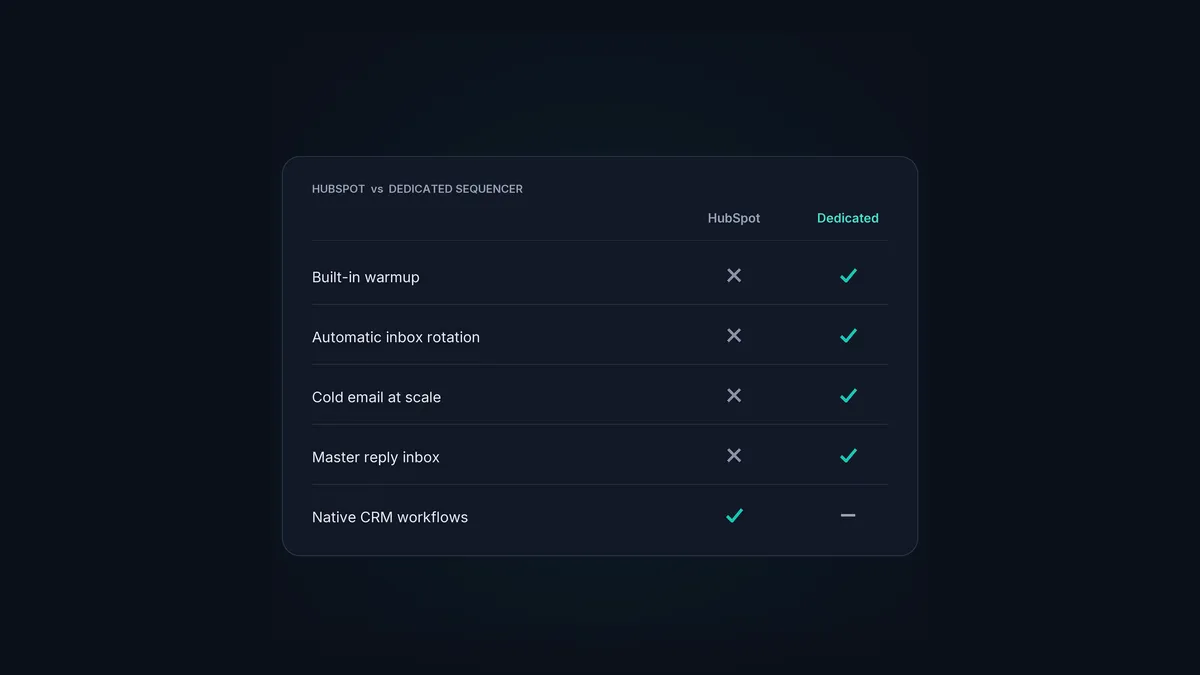
HubSpot is excellent at what it is built for. Its sequences are a genuinely useful feature for following up with contacts already in your CRM, the warm leads, the deals in motion, the people who filled in a form. The trouble starts when teams try to use them for cold outreach at scale, which is a different job that HubSpot sequences were never designed to do.
This is not a knock on HubSpot. It is about using the right tool for the right job. Here is where HubSpot sequences shine, where they fall down for cold email, and how to think about running both.
The short version
- HubSpot sequences are built for warm, CRM-connected follow-up, and they are good at it.
- For cold outreach at scale they fall short: no native warmup, no inbox rotation, and deliverability risk to your main domain.
- Cold email needs a deliverability-first sender, not a CRM with sending bolted on.
- You do not have to choose: keep HubSpot as your CRM and run cold outreach in a dedicated sequencer, synced back.
- Match the tool to the temperature of the contact: warm in HubSpot, cold in a dedicated sequencer.
What HubSpot sequences are good at
For their intended job, HubSpot sequences are a strong feature:
- Warm follow-up. Chasing a lead who already knows you, nudging a stalled deal, following up after a demo. The contact is in the CRM and the relationship exists.
- CRM-native everything. Every send, open and reply is logged against the contact and deal automatically, with no integration to maintain. Personalisation pulls from CRM fields.
- Tight workflow integration. Sequences sit inside the same tool as your pipeline, tasks and reporting, so reps live in one place.
If your outreach is to people already in your CRM, this is hard to beat. The CRM context is the whole point, and a dedicated cold email tool cannot match it without integration work.
Where HubSpot sequences fall down for cold email
Cold outreach is a different game, and it is played on deliverability. This is where a CRM’s built-in sequences struggle:
- No native warmup. Cold sending at volume needs warmed mailboxes to protect sender reputation. HubSpot does not warm inboxes, because its sequences assume warm, low-volume sending.
- No inbox rotation. Cold email at scale spreads sends across many mailboxes to keep each one’s volume natural. HubSpot sends from your connected mailbox, concentrating volume.
- Reputation risk to your main domain. HubSpot sends tie cold volume to the same domain you run your business on. A cold campaign that goes wrong can damage the deliverability of your normal email.
- No master reply inbox. Cold outreach across many mailboxes needs one place to catch every reply, including forwards and CC’d colleagues, and route them. That is not what a CRM inbox is for.
- Volume and cost limits. Sequence enrolment caps and per-seat pricing make high-volume cold sending awkward and expensive.
None of these are bugs. They are the natural result of a tool built for warm, CRM-connected follow-up being asked to do cold outreach at scale. The deliverability stack a cold sender needs simply is not there, because it was never meant to be.
What a dedicated email sequencer does differently
A purpose-built cold email sequencer is designed around the thing HubSpot is not: deliverability at volume. That means native warmup on real inboxes, automatic inbox rotation across many mailboxes, sending isolated from your main domain, and a master reply inbox that catches and routes every reply.
In other words, it treats cold outreach as its core job rather than a feature bolted onto a CRM. For the full picture of what to look for, see best email sequencing tool.
You do not have to choose
The best setup for most teams is not “HubSpot or a sequencer”. It is both, each doing its job. Keep HubSpot as your CRM and your home for warm, in-pipeline follow-up. Run your cold outreach in a dedicated sequencer on separate, warmed mailboxes, and sync the results back into HubSpot so your CRM stays the source of truth.
That way the cold volume never touches your main domain, your reps still see everything in the CRM, and each tool does what it is genuinely good at. HotHawk supports two-way sync with HubSpot and Salesforce for exactly this reason.
Keep HubSpot, send cold properly
Run cold outreach in HotHawk on warmed, rotated mailboxes, with the best reply inbox in cold email, and sync it all back to HubSpot. Try it free for 7 days.
Start your 7 day free trialA few common questions
Can I use HubSpot sequences for cold email? You can, but it is risky. HubSpot lacks native warmup and inbox rotation, and cold volume on your main domain can hurt your normal email’s deliverability. It is built for warm, CRM-connected follow-up.
When is HubSpot enough? When your outreach is to contacts already in your CRM, at modest volume: warm leads, stalled deals, post-demo follow-up. That is exactly what it is built for.
Do I have to replace HubSpot? No. Keep it as your CRM and run cold outreach in a dedicated sequencer, syncing results back. Each tool does its own job.
HubSpot sequences are a great warm-follow-up tool and a poor cold-outreach tool, and that is fine, because they were built for the former. For cold email at scale you need a deliverability-first sequencer. Use both, point each at the job it does well, and keep your cold volume off the domain your business depends on.
